Matching dimensions alone is a recipe for catastrophic failure.
A reliable FAG to US brand interchange table requires matching not just basic dimensions, but hidden parameters like internal clearance and cage materials to ensure true functional equivalence. Without aligning these critical specifications, a direct dimensional swap often leads to premature overheating and seizure.
I still remember the humidity in that Dongguan assembly workshop. A client’s conveyor line had stopped, and they needed a spherical roller bearing replacement immediately. I grabbed what looked like a perfect American equivalent based on the outer diameter and bore size. It fit perfectly into the housing. But within a week, the unit seized due to excessive heat. The mistake was not the size; it was the internal clearance and the cage material. That mid-six-figure loss taught me that a FAG to US brand interchange table is useless if you ignore the suffixes.
To avoid such costly errors, distributors and MRO managers must look beyond the part number. This guide breaks down how to read these tables correctly, focusing on the technical nuances that define true interchangeability.
Why Do Basic Dimensions Fail in FAG to US Interchanges?
Dimensional parity is just the baseline; thermal and load dynamics dictate true interchangeability.
Most buyers assume that if the bore, outside diameter, and width match, the bearings are interchangeable. This is a dangerous oversimplification. German engineering standards (DIN/ISO) and American standards (ABMA/ANSI) often differ in their approach to tolerances and internal design.
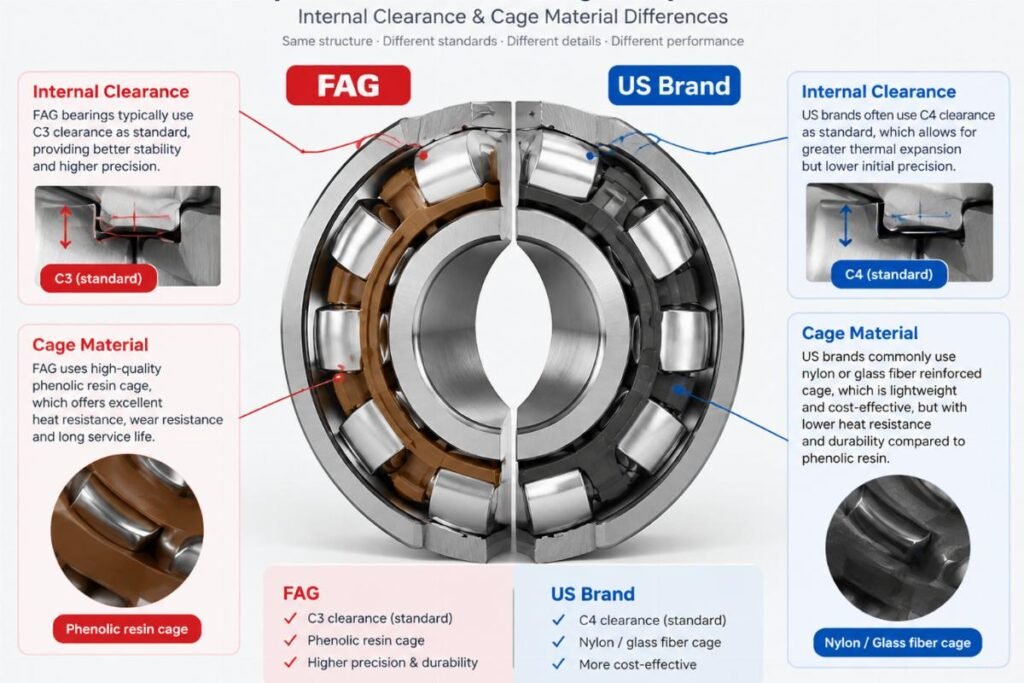
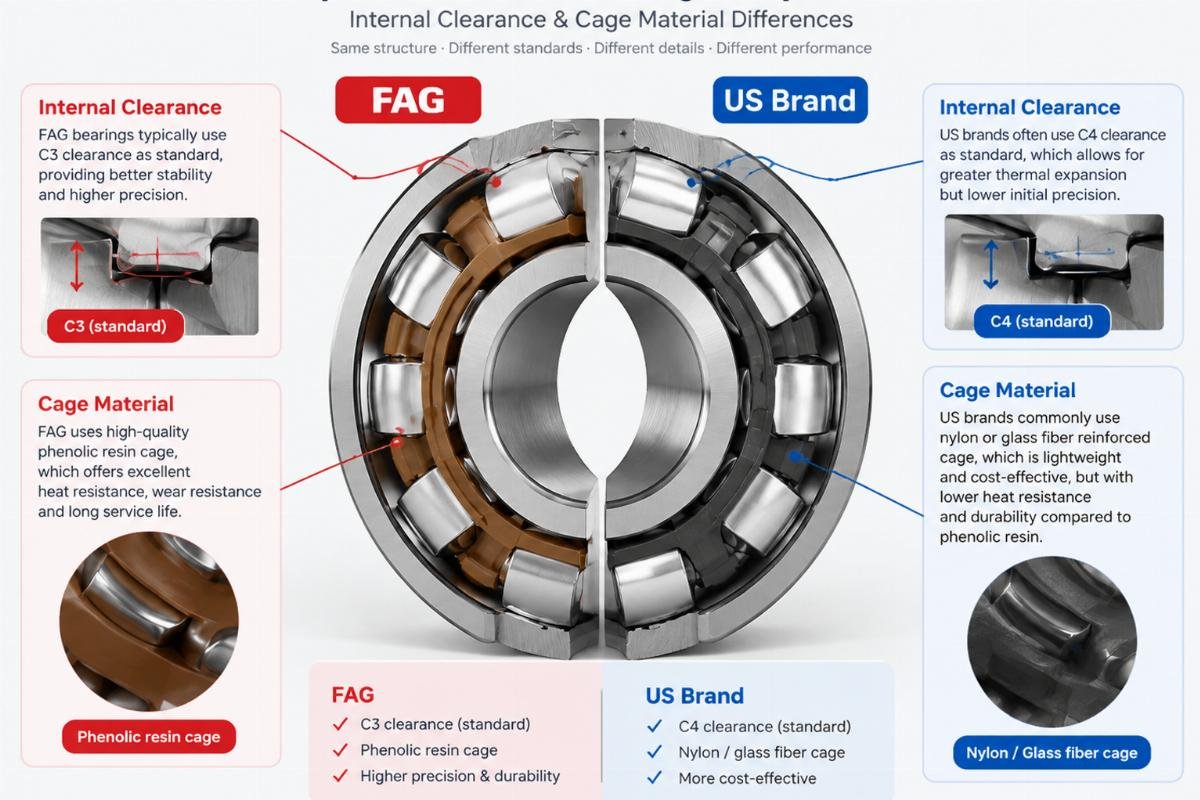
When I source for heavy equipment OEMs, I see this issue frequently. A FAG bearing might have a specific radial internal clearance that differs from its US counterpart, even if the external dimensions are identical. If you install a US bearing with standard clearance in an application designed for FAG’s C3 clearance, the rolling elements may bind as the shaft expands under load.
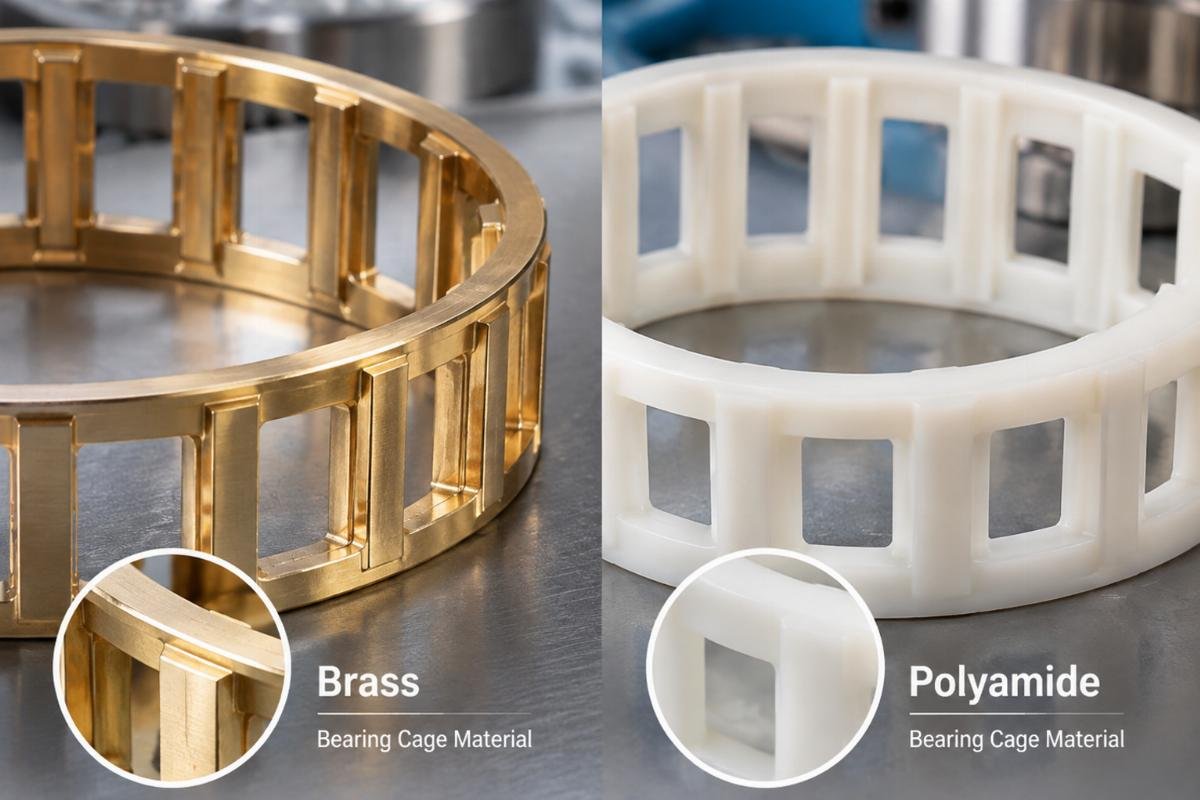
Consider a case where a mining crusher operator switched to a US brand for cost savings. The dimensions were perfect, but the cage design was different. The original FAG unit used a machined brass cage, which offers high strength and thermal stability. The US substitute used a polyamide cage. Under the heavy shock loads of the crusher, the polyamide degraded faster, leading to cage fracture.
This is why a FAG to US brand interchange table must include data on cage types and clearance groups. Ignoring these factors turns a simple replacement into a reliability risk.
How to Read the FAG to US Brand Interchange Table Correctly?
Step-by-step guide to mapping basic codes, suffixes, and internal designations between German and American systems.
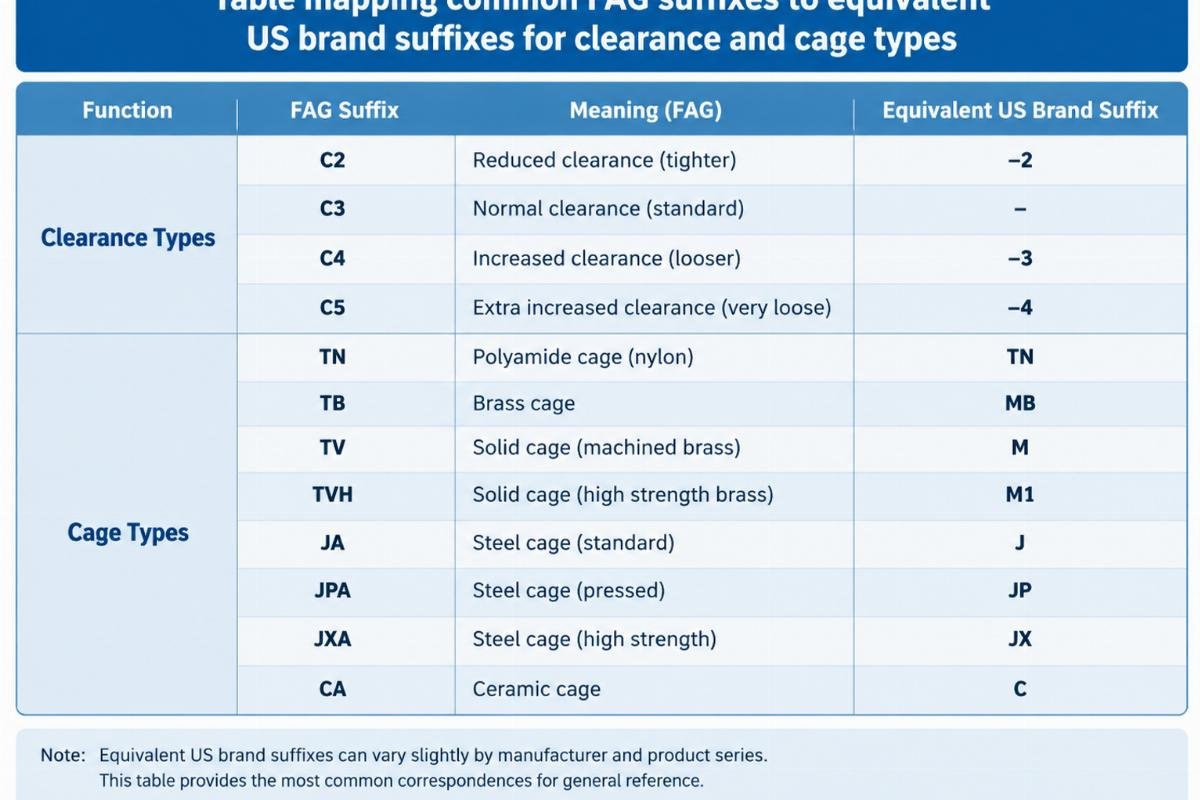
Reading a FAG to US brand interchange table requires decoding the suffixes. These letters and numbers hold the key to the bearing’s internal architecture. Here is how to map them effectively:
- Identify the Basic Designation: Start with the core number (e.g., 22210). This defines the boundary dimensions. Ensure this matches exactly across brands.
- Decode the Clearance Suffix: FAG uses C2, C3, C4, etc. US brands like Timken or SKF (US production) may use similar codes, but sometimes they use different notations for specific series. Always verify the actual micron range of the clearance.
- Map the Cage Material: Look for suffixes indicating cage type. For example, FAG might use “M” for machined brass cage. In US brands, this might be denoted differently or assumed as standard. Verify if the substitute uses steel, brass, or polymer.
- Check Seal and Shield Codes: If the bearing is sealed, ensure the seal material (rubber compound) and contact type match. A non-contact seal in one brand might be a contact seal in another, affecting friction and speed limits.
A common error is ignoring the tolerance class. FAG bearings often adhere to strict P0 or P6 tolerances. When switching to a US brand, confirm that the tolerance class meets the original equipment manufacturer’s requirements. A looser tolerance can cause vibration and noise in precision applications.
What Are the Critical Hidden Parameters to Verify?
Deep dive into aligning internal clearance (C3/C4), cage materials, and tolerance classes to prevent field failures.
The most critical hidden parameters in a FAG to US brand interchange table are internal clearance and cage material. These factors directly influence the bearing’s lifespan and operational temperature.
Internal Clearance:
FAG typically categorizes clearance into C2, Normal, C3, C4, and C5. In high-temperature environments, such as steel mills or cement plants, C3 or C4 is often required to accommodate thermal expansion. If you replace a FAG C3 bearing with a US brand’s “Standard” clearance, which might equate to Normal or C2, the bearing will overheat.
Cage Material:
- Brass Cages: Common in FAG spherical roller bearings for heavy loads. They offer excellent guidance and heat resistance.
- Polyamide Cages: Lighter and cheaper, but sensitive to high temperatures and certain chemicals.
- Steel Cages: Robust but heavier.
If a FAG bearing specifies a brass cage, substituting it with a polyamide cage from a US brand can lead to premature failure in harsh conditions. I once helped a distributor consolidate a mixed batch order. They needed to ensure that all US equivalents matched the FAG specifications for cage type to maintain consistency for their end-users.
Tolerance Classes:
While ISO and ABMA standards are harmonized in many areas, subtle differences exist. For precision applications, verify that the US brand’s tolerance class matches the FAG specification. A mismatch in runout or radial play can cause significant issues in high-speed spindles or gearboxes.
How to Source Mixed-Brand Interchange Packages Safely?
Best practices for procuring genuine FAG and US equivalents from consolidated suppliers with full traceability.
Sourcing from a reliable FAG to US brand interchange table provider involves more than just picking part numbers. It requires verifying authenticity and traceability.
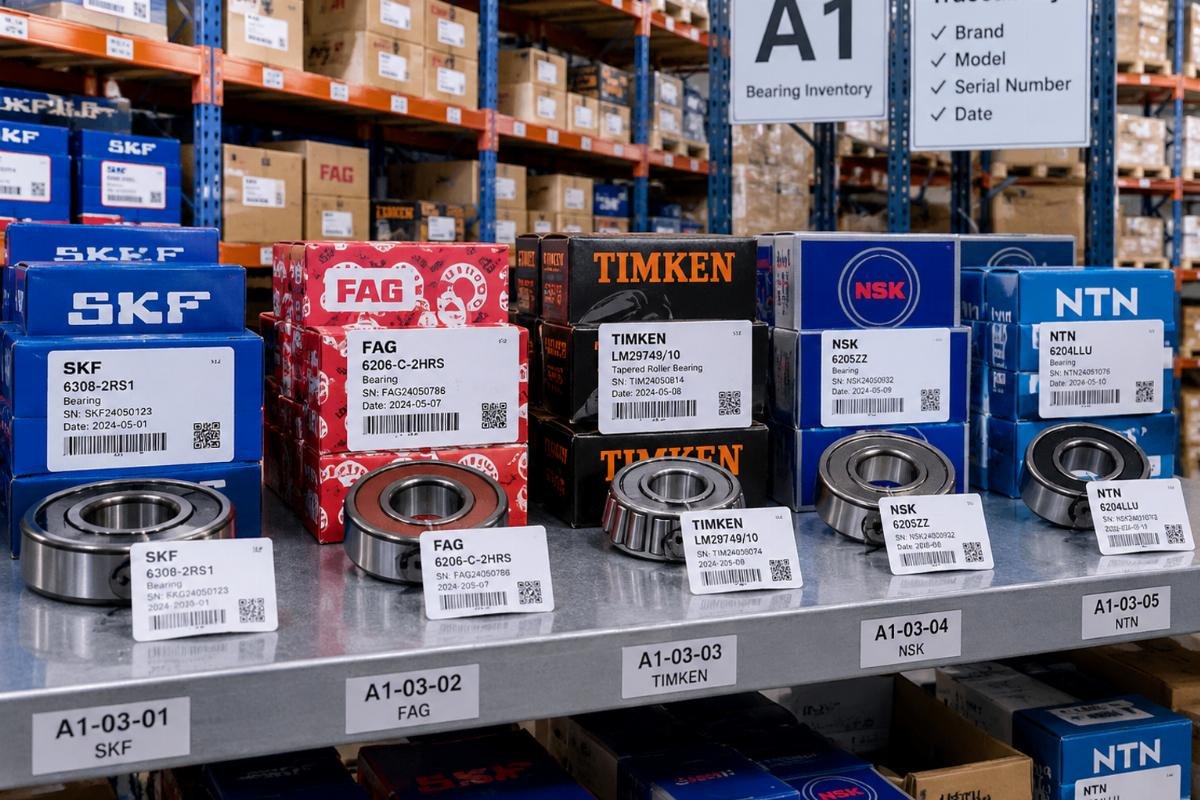
When dealing with mixed-brand orders, ensure that the supplier provides full documentation for each brand. Genuine FAG bearings come with specific packaging and marking features. Similarly, US brands like Timken have distinct authentication markers.
A major risk in mixed-batch sourcing is receiving counterfeit or refurbished parts passed off as new. To mitigate this, work with suppliers who offer direct traceability to the manufacturer. This is crucial for MRO managers who need to minimize downtime without compromising reliability.
For example, a regional distributor in Southeast Asia needed to fulfill a bulk order mixing FAG and US equivalents. By working with a supplier who could provide technical consultation and verify the suffix mapping for cage and seal types, they ensured that every unit met the required specifications. This approach reduced the risk of field failures and maintained customer trust.
Additionally, consider the lead times. While US brands might offer faster availability in some regions, FAG might have better stock levels for specific precision grades. A flexible supplier can balance these factors, offering a consolidated shipment that meets both technical and logistical needs.
Conclusion
True interchangeability lies in the details, not just the dimensions.
A FAG to US brand interchange table is a powerful tool only when used with a deep understanding of internal clearance, cage materials, and tolerance classes. By focusing on these hidden parameters, you can ensure reliable replacements and avoid costly downtime. Always verify the suffixes and consult technical experts when in doubt.