Most bearing failures in port cranes are not caused by overload, but by microscopic clearance mismatches and contaminated lubrication.
Sourcing genuine FAG bearings for US port cranes requires strict verification of traceability and precise working condition matching to prevent catastrophic failures and massive downtime costs. The primary risk is not just mechanical wear, but the installation of counterfeit or incorrectly specified units that lack the necessary internal clearance tolerances for heavy dynamic hoisting loads.
I still remember the sound of metal shearing on a quayside in Lagos. A customer had opted for a cheaper alternative for the hoisting mechanism of a ship-to-shore crane. Within months, the spherical roller bearing cage fractured under load. The spreader dropped onto the deck, halting port operations and triggering a chain of claims that cost far more than the initial savings. That incident shifted my focus from simple transactional sales to rigorous technical verification. Now, when handling orders for US port infrastructure, I prioritize checking the specific lubrication conditions and load profiles before confirming any part number. A deviation of a fraction of a millimeter in internal clearance or the introduction of a refurbished unit can lead to repairs costing hundreds of thousands of dollars.

Understanding these risks is critical for maintenance, repair, and operations (MRO) managers who need to ensure reliability. This guide details how to select, verify, and source authentic components effectively.
Why Do Port Crane Bearings Fail Prematurely?
Premature failure is often a result of environmental contamination and incorrect internal clearance rather than excessive load.
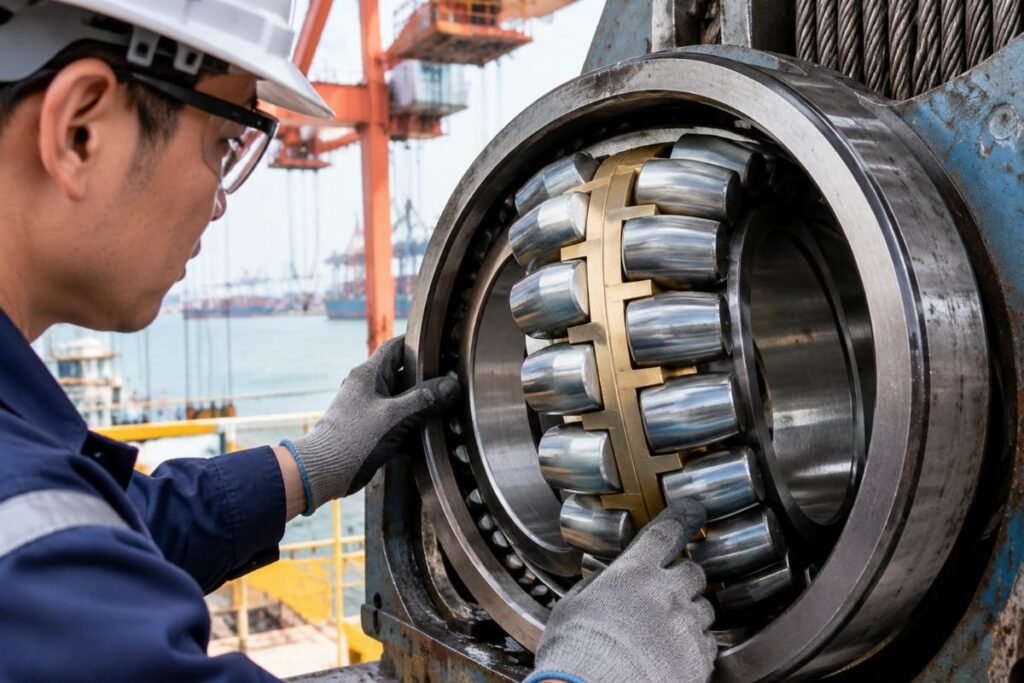
Port cranes operate in some of the harshest industrial environments. Salt spray, humidity, and constant vibration create a perfect storm for bearing degradation. While many operators assume that a broken bearing was simply pushed beyond its load limit, the root cause is frequently more subtle. Microscopic contamination in the lubricant or an improper fit during installation can initiate fatigue cracks long before the rated load capacity is reached.
In marine environments, water ingress is a persistent threat. If the sealing solution is inadequate or if the lubrication interval is not optimized for high-humidity conditions, the grease emulsifies. This loss of lubricity leads to metal-to-metal contact, generating heat and accelerating wear. I have seen cases where standard grease was used instead of marine-grade formulations, resulting in rapid corrosion of the raceways. The bearing might look intact from the outside, but internally, the surface integrity is compromised.
Another common issue is misalignment. Trolley travel systems require precise alignment to ensure even load distribution across the roller elements. If the housing bore is not machined to the correct tolerance or if the shaft deflection is not accounted for in the bearing selection, edge loading occurs. This concentrates stress on a small area of the raceway, leading to premature spalling. It is not always about buying the most expensive bearing; it is about buying the right bearing for the specific application conditions.

For MRO teams, recognizing these signs early can prevent unplanned downtime. Regular vibration analysis and thermal imaging can detect these issues before they become catastrophic. However, the foundation of reliability remains the correct initial selection and installation of high-quality components.
How to Verify Genuine FAG Bearings Before Installation?
Verification must shift from visual inspection to rigorous documentation and traceability checks.
The market is flooded with counterfeit bearings that mimic the packaging and markings of premium brands. For critical applications like port cranes, relying solely on the appearance of the product is a significant risk. Counterfeit units often use inferior steel with higher inclusion levels, which drastically reduces fatigue life.
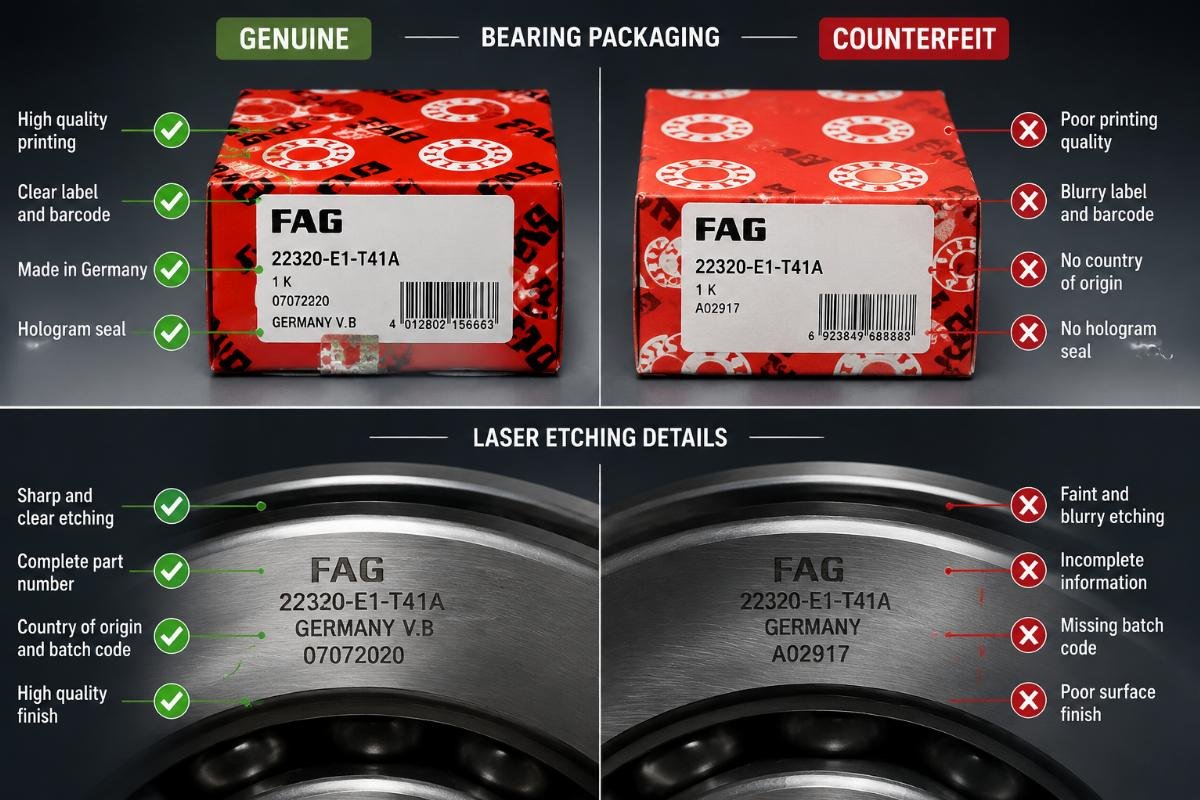
To ensure authenticity, start with the packaging. Genuine products come in sealed, branded packaging with specific security features. Check for holographic labels, QR codes, or batch numbers that can be verified through the manufacturer’s official channels. The printing quality should be sharp and consistent, with no spelling errors or blurred logos.
Next, examine the physical markings on the bearing itself. Laser etching or deep stamping should be clear and evenly spaced. Counterfeit items often have shallow or uneven markings. The surface finish of the genuine bearing should be smooth and free from machining marks or discoloration. Any sign of rust or roughness on the outer diameter or bore is a red flag.
Documentation is the most reliable verification tool. Request the certificate of origin and material test reports from your supplier. A reputable supplier will provide complete traceability documents that link the bearing to its production batch. If a supplier cannot provide these documents or hesitates to share them, it is a strong indicator that the product may not be genuine.
When sourcing FAG bearings for US port cranes, insist on full traceability. This not only ensures authenticity but also provides a record for warranty claims and quality audits. Our approach involves maintaining strict chain-of-custody records for every unit shipped, ensuring that what arrives on site is exactly what was ordered from the manufacturer’s production facilities.
What Are the Key Selection Parameters for Crane Hoisting & Trolley Systems?
Selection must match specific dynamic loads and precision requirements, focusing on internal clearance and cage design.
Choosing the right bearing involves more than just matching the shaft diameter. For hoisting mechanisms, spherical roller bearings are commonly used due to their ability to accommodate misalignment and heavy radial loads. However, the internal clearance class is critical. In high-load applications, a standard clearance may lead to premature failure due to thermal expansion and load-induced deformation. Selecting a C3 or C4 clearance class can provide the necessary room for operation without compromising stability.
The cage material and design also play a vital role. Steel cages are robust and suitable for high-speed applications, while brass cages offer better damping properties and are often preferred in vibrating environments. For port cranes, where shock loads are common, a reinforced steel cage can provide additional durability.
For trolley travel systems, cylindrical roller bearings are often selected for their high radial load capacity and low friction. Precision is key here, as any deviation in roundness or parallelism can cause uneven wear and noise. P5 or P6 precision classes are typically required to ensure smooth operation and long service life.
| Parameter | Hoisting Mechanism | Trolley Travel System |
|---|---|---|
| Bearing Type | Spherical Roller Bearing | Cylindrical Roller Bearing |
| Load Profile | Heavy Radial & Shock Loads | High Radial & Moderate Axial Loads |
| Internal Clearance | C3 or C4 | Standard or C3 |
| Precision Class | Normal or P6 | P5 or P6 |
| Cage Material | Reinforced Steel | Brass or Steel |
This table highlights the general differences, but specific applications may require adjustments. Always consult the OEM technical manuals and consider the specific operating conditions of the crane.
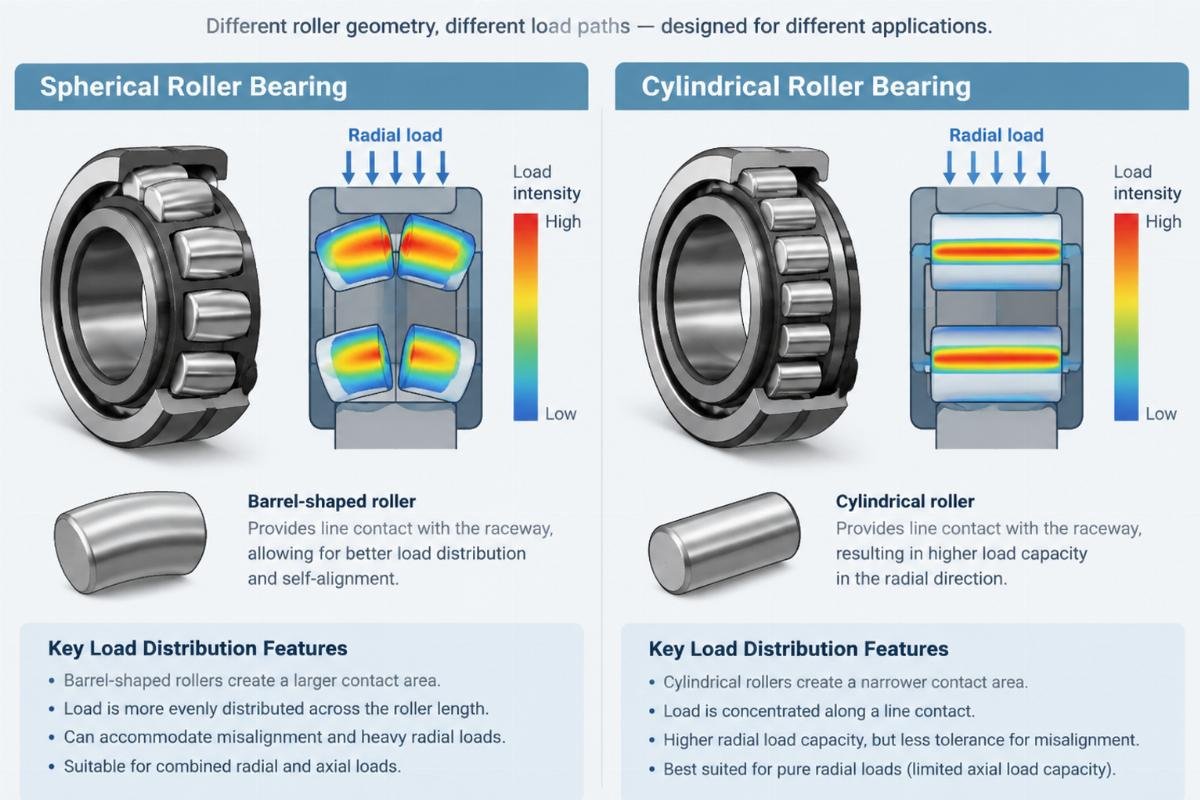
Incorrect selection can lead to significant efficiency losses and increased maintenance costs. By matching the bearing specifications to the actual working conditions, operators can maximize uptime and extend the service life of their equipment.
How to Optimize MRO Sourcing for Mixed-Batch Crane Maintenance?
Flexible sourcing strategies and global consolidation can minimize unplanned downtime and reduce logistics complexity.
Emergency replacements are a reality in port operations. Waiting weeks for a single bearing to arrive from a distant warehouse is not an option when a crane is down. Optimizing MRO sourcing involves having access to a diverse inventory and a supplier capable of rapid consolidation.
Many operators struggle with the minimum order quantities (MOQs) imposed by official brand channels. This can lead to overstocking of slow-moving items and stockouts of critical spares. A flexible supplier can offer mixed-brand and mixed-size packages, allowing you to order exactly what you need for a specific overhaul project. This reduces capital tied up in inventory and ensures that all necessary components are available when needed.
Global consolidation services further streamline the process. Instead of managing multiple shipments from different suppliers, a single consolidated shipment can include bearings from various brands, such as SKF, NSK, and TIMKEN, alongside genuine FAG units. This simplifies customs clearance and reduces shipping costs.
I recall assisting a US port operator who needed an urgent overhaul of several gantry cranes. By leveraging our spot inventory and consolidation capabilities, we were able to deliver a mixed batch of bearings within days, rather than weeks. This rapid response prevented extended downtime and allowed the port to maintain its scheduling commitments.

Building a relationship with a supplier who understands the urgency of MRO requirements is essential. Look for partners who offer technical support for cross-referencing equivalent models and who can provide reliable lead times for both standard and special items. This strategic approach to sourcing ensures that your maintenance team is always equipped to handle unexpected challenges.
Conclusion
Reliability in port crane operations depends on precise selection, rigorous verification, and agile sourcing.
Avoiding catastrophic failures requires a proactive approach to bearing management. By understanding the root causes of failure, verifying the authenticity of every unit, and selecting the correct specifications for each application, operators can significantly enhance equipment longevity. Partnering with a supplier who offers genuine products, complete traceability, and flexible sourcing solutions ensures that your maintenance strategy is both effective and efficient.