Matching basic dimensions is not enough.
To successfully substitute Sealmaster inserts with FAG equivalents, you must verify the locking mechanism compatibility, radial clearance class, and set screw torque specifications rather than relying solely on bore and outer diameter measurements. Ignoring these technical nuances leads to inner ring slippage and premature bearing failure in heavy-load applications.
I still remember the panic in a client’s email from the Midwest during harvest season. A critical combine harvester had gone down, and the local distributor was out of stock of the specific Sealmaster pillow block bearing required. The downtime cost was mounting by the hour. I quickly identified an FAG insert bearing with identical bore and outer dimensions, assuming it would be a drop-in replacement. We shipped it overnight. Two days later, the machine was back online, but only for a few hours. The bearing had failed catastrophically. The inner ring had spun on the shaft, scoring the metal and destroying the housing. It wasn’t a quality issue; it was a compatibility oversight. The Sealmaster unit used a specific eccentric locking collar design with a distinct tolerance band, while the FAG equivalent relied on a different set screw geometry and clearance profile. That incident shifted my entire approach to cross-brand sourcing. Now, when buyers ask for FAG equivalents for Sealmaster inserts, I do not just look at the catalog dimensions. I dig into the engineering specs.

This guide breaks down exactly how to navigate these substitutions safely. For distributors and MRO managers holding inventory or managing emergency repairs, understanding these details is the difference between a quick fix and a costly recall.
How to cross-reference Sealmaster to FAG?
Start with the locking mechanism, not the bore size.
The most common mistake in cross-referencing is assuming that if the bore diameter (e.g., 1 inch or 25mm) and outer diameter match, the bearings are interchangeable. While this holds true for standard deep groove ball bearings, insert bearings for pillow blocks are engineered systems. Sealmaster and FAG use different methods to secure the inner ring to the shaft. Sealmaster often employs an eccentric locking collar or a specific set screw pattern that applies preload differently than FAG’s standard wide inner ring designs.
When you request FAG equivalents for Sealmaster inserts, the first step is to identify the exact Sealmaster series. Is it the MP (medium duty) or HP (heavy duty) series? Each has a distinct internal geometry. FAG’s corresponding YAR or YEJ series may share the same external envelope, but the internal fit can vary. For instance, the angle of the set screws in FAG bearings is often optimized for different torque values compared to Sealmaster. If you install an FAG bearing into a Sealmaster housing without adjusting the tightening procedure, you risk under-tightening, which leads to slippage, or over-tightening, which distorts the raceway.
Consider a case involving a mining conveyor operator in South America. They switched to FAG equivalents for Sealmaster inserts to reduce lead times. The procurement team matched the part numbers based on bore size alone. Within weeks, multiple bearings showed signs of fretting corrosion on the shafts. The root cause was the mismatch in the locking collar’s grip strength. The FAG units required a higher initial torque to achieve the same clamping force as the Sealmaster originals. By verifying the manufacturer’s installation guidelines before deployment, such failures can be avoided. Always request the technical datasheet for both the original and the proposed equivalent to compare the locking method details.

What locking & tolerance details matter?
Tolerance bands dictate fit, not just function.
Beyond the locking mechanism, the radial internal clearance is a critical parameter. Bearings are not static components; they expand and contract with temperature changes and load variations. Sealmaster bearings often come with a specific clearance class suited for agricultural and moderate industrial applications. FAG, being a premium European brand, offers a wider range of clearance options, including C3 and C4 classes for high-temperature or high-speed environments.
If you replace a standard clearance Sealmaster bearing with a C3 FAG equivalent in a low-speed, high-load application, the increased clearance might allow excessive vibration. Conversely, using a standard clearance FAG bearing in a high-heat environment where a C3 was originally specified can lead to pre-loading and early fatigue. This is why simply matching the part number prefix is insufficient. You must confirm the clearance code.
When sourcing FAG equivalents for Sealmaster inserts, pay attention to the tolerance of the shaft fit. Sealmaster inserts are designed to accommodate slight shaft imperfections, common in field repairs. FAG bearings, with their tighter manufacturing tolerances, may require a smoother shaft surface to perform optimally. If the existing shaft has minor scoring or wear, the stricter tolerance of the FAG bearing might not seat properly, leading to uneven load distribution.
A European wind farm maintenance team learned this the hard way. They replaced worn Sealmaster bearings in pitch control systems with FAG equivalents. The new bearings failed prematurely due to micro-movements caused by a mismatch in the shaft tolerance class. The Sealmaster units had a more forgiving fit, while the FAG units required a precise h6 or h7 shaft tolerance. After regrinding the shafts to meet FAG specifications, the issues resolved. This highlights the importance of checking not just the bearing, but the entire assembly context.
| Feature | Sealmaster Typical Spec | FAG Equivalent Consideration |
|---|---|---|
| Locking Mechanism | Eccentric Collar / Set Screw | Wide Inner Ring / Set Screw |
| Radial Clearance | Standard (CN) | Verify CN, C3, or C4 requirement |
| Shaft Tolerance | Forgiving of minor wear | Requires precise h6/h7 fit |
| Lubrication | Pre-lubed for general use | Check grease compatibility and type |

How to verify equivalents before ordering?
Demand data, not just part numbers.
Before placing a bulk order for FAG equivalents for Sealmaster inserts, implement a verification protocol. Do not rely on supplier claims alone. Request the dimensional drawings for both the original Sealmaster part and the proposed FAG alternative. Compare the width of the inner ring, the position of the set screws, and the overall height of the bearing. Even a millimeter difference in the inner ring width can affect how the bearing sits in the pillow block housing, potentially causing misalignment with the seals.
Another critical check is the seal type. Sealmaster uses various seal designs, including triple-lip and flinger seals, depending on the series. FAG offers a range of sealing solutions, such as RSZ or RSR seals. Ensure that the FAG seal material is compatible with the operating environment. If the application involves washdowns or chemical exposure, the standard rubber seals on the FAG equivalent might degrade faster than the original Sealmaster seals. Verify the material composition, such as NBR or FKM, to ensure longevity.
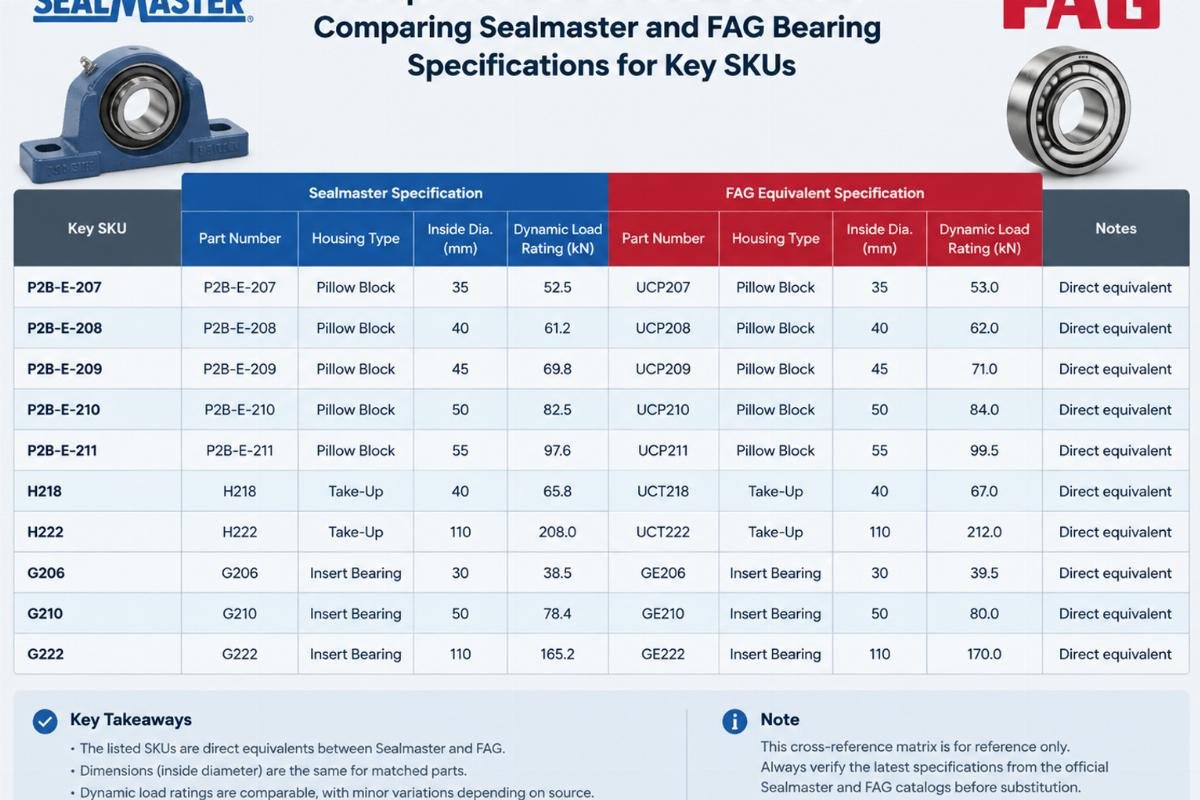
For distributors, creating a cross-reference matrix is invaluable. List the top-moving Sealmaster SKUs and map them to their verified FAG counterparts, noting any specific installation adjustments required. This adds value to your customers and reduces return rates. When a customer asks for FAG equivalents for Sealmaster inserts, you can provide not just the part number, but a brief technical note on any necessary changes in installation practice.
What are the risks of ignoring specs?
Failure costs far exceed the savings.
Ignoring the technical nuances of bearing substitution carries significant risks. The most immediate risk is mechanical failure, as seen in the combine harvester example. But beyond the component cost, there is the cost of downtime, labor for re-installation, and potential damage to adjacent machinery. In critical applications like mining or steel production, a bearing failure can halt an entire production line, resulting in losses that dwarf the price difference between brands.
Furthermore, using incompatible bearings can void warranties. If a machine manufacturer specifies Sealmaster bearings for a reason, substituting them with FAG equivalents without engineering approval may void the equipment warranty. This is particularly relevant for OEMs who source bearings for new builds. They must ensure that any alternative meets the original design intent.
There is also the reputational risk for distributors. If you supply FAG equivalents for Sealmaster inserts that fail prematurely due to improper selection, your credibility suffers. Customers expect expertise, not just parts. By demonstrating a deep understanding of the technical differences, you build trust and long-term relationships. It shows that you care about their operational success, not just the transaction.
Conclusion
Precision matters more than parity.
Substituting Sealmaster bearings with FAG equivalents is a viable strategy for reducing lead times and costs, but it requires careful technical validation. Focus on the locking mechanism, radial clearance, and shaft tolerance rather than just basic dimensions. By verifying these details, you ensure reliable performance and avoid costly failures. For those seeking reliable FAG equivalents for Sealmaster inserts, thorough due diligence is the key to success.