Dimensional interchangeability is a dangerous myth in heavy-duty applications.
Choosing between FAG and Kaydon large bearings depends strictly on matching exact load profiles to the application, not just dimensions or price. FAG excels in rugged spherical and cylindrical roller designs for high-shock, heavy-load environments like mining crushers, while Kaydon dominates in precision thin-section and cross-roller configurations for space-constrained, high-stiffness axes such as robotics and medical imaging. Mismatching these brands based solely on outer diameter leads to premature raceway cracking or excessive play, regardless of the initial cost savings.
I still remember the dust coating my boots in Ningbo, standing next to a massive excavator slewing ring that had failed prematurely. The maintenance team had swapped a heavy-duty FAG spherical roller unit for a cheaper Kaydon thin-section bearing, assuming the similar bore size meant they were interchangeable. Within weeks, the thin-section raceway cracked under the shock loads typical of that pit, halting the entire operation. That teardown taught me that large bearings are not commodities defined by millimeters alone; they are engineered solutions defined by load distribution. When buyers now ask me to compare options for bulk orders, I do not just look at the part number. I analyze whether the application demands the rugged load capacity of FAG or the precision stiffness of Kaydon. This distinction is critical for any FAG vs Kaydon Large Bearings evaluation.

Understanding this fundamental difference prevents costly downtime. The following analysis breaks down how to select the right brand for your specific operational needs, ensuring your procurement strategy aligns with engineering reality rather than just catalog availability.
What Are the Core Design Differences Between FAG and Kaydon Large Bearings?
FAG focuses on rugged spherical and cylindrical rollers for heavy loads, while Kaydon excels in precision thin-section and cross-roller designs.
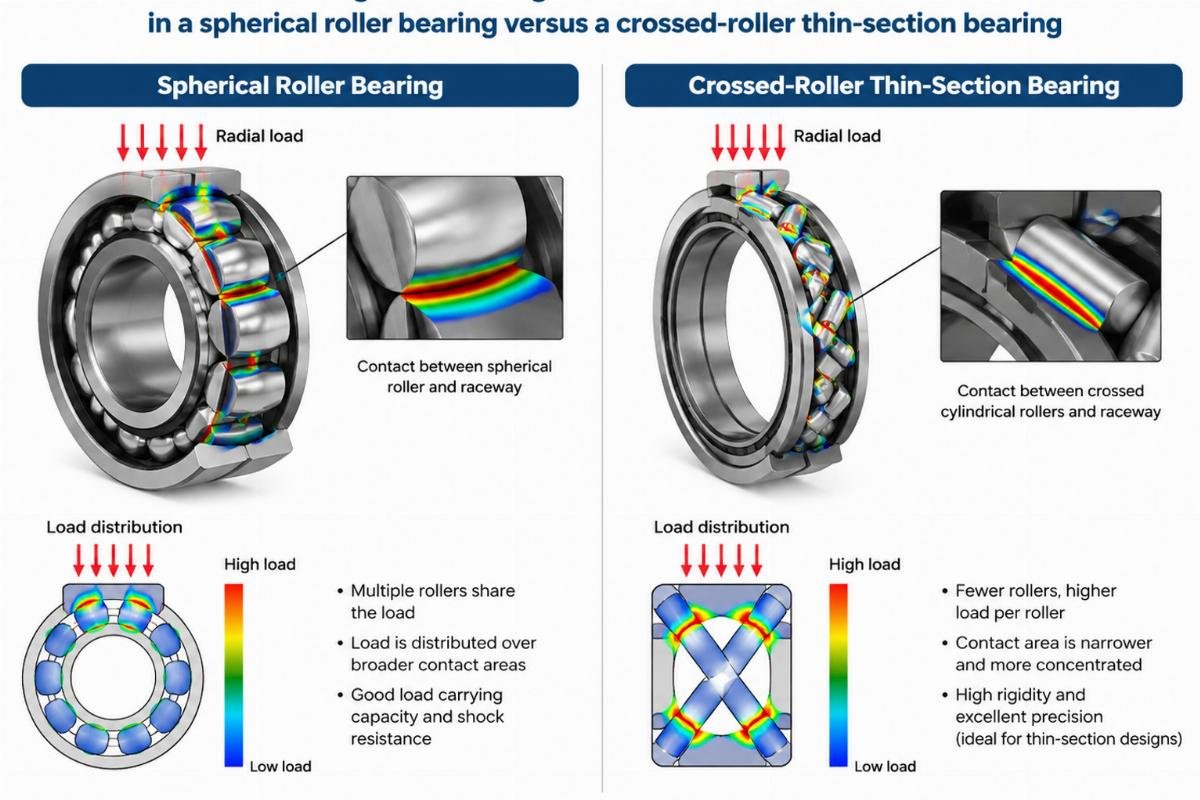
The primary divergence between these two giants lies in their engineering philosophy and core product architectures. FAG, part of the Schaeffler group, has built its reputation on robustness. Their large bearings, particularly spherical roller bearings, are designed to accommodate misalignment and withstand severe shock loads. The internal geometry allows for significant load distribution across multiple rollers, making them ideal for harsh environments where vibration and impact are constant.
In contrast, Kaydon (part of SKF) pioneered the thin-section bearing market. Their designs prioritize space and weight savings without sacrificing rigidity. Kaydon’s large bearings, often featuring crossed-roller or angular contact configurations, provide high rotational accuracy and stiffness in a compact envelope. This makes them the go-to choice for applications where radial space is limited but precision is paramount, such as in radar antennas or surgical robots.
| Feature | FAG Large Bearings (Spherical/Cylindrical) | Kaydon Large Bearings (Thin-Section/Cross-Roller) |
|---|---|---|
| Primary Design Focus | Heavy load capacity, shock resistance, misalignment tolerance | Space saving, high precision, high stiffness, low friction |
| Typical Roller Type | Spherical or Cylindrical Rollers | Crossed Rollers, Angular Contact Balls |
| Load Profile Suitability | High radial/axial loads with frequent shock impacts | Moderate loads requiring precise positioning and rigidity |
| Ideal Environment | Mining, construction, steel mills, heavy machinery | Robotics, medical equipment, aerospace, precision turntables |
| Misalignment Handling | Excellent (self-aligning capabilities) | Low (requires precise housing alignment) |
A common mistake in procurement is assuming that a larger bearing automatically means higher durability. However, a large Kaydon thin-section bearing may have a lower dynamic load rating than a smaller FAG spherical roller due to the difference in roller geometry and contact area. When evaluating FAG vs Kaydon Large Bearings, one must look beyond the outer diameter and examine the internal load paths. For instance, in a mining crusher application, the erratic shock loads require the self-aligning feature of FAG bearings to prevent edge loading. Conversely, in a precision indexing table, the minimal play offered by Kaydon’s pre-loaded cross rollers ensures accurate positioning, which FAG’s looser tolerance spherical rollers might not provide.
How Do Shock Loads and Precision Requirements Dictate Your Choice?
High-shock mining environments demand FAG’s load distribution; precision robotics or space-constrained axes require Kaydon’s stiffness.
The decision matrix for selecting between these brands often comes down to two opposing forces: shock absorption and positional accuracy. In industries like mining and aggregate processing, equipment is subjected to relentless impact. A jaw crusher, for example, experiences sudden, high-magnitude forces as rocks are fractured. Here, the elastic deformation capability of FAG’s spherical rollers acts as a buffer, distributing stress evenly across the raceway. If a thinner, stiffer bearing were used, the lack of compliance would lead to stress concentrations, causing spalling or catastrophic fracture.
On the other end of the spectrum, consider a semiconductor wafer handling robot. The requirement here is not to absorb a ten-ton rock impact, but to move a delicate substrate with micron-level precision. Any deflection in the bearing structure translates directly to positioning error. Kaydon’s thin-section bearings, with their optimized cross-sectional geometry, offer superior moment rigidity. They resist tilting under load, ensuring that the axis of rotation remains stable. Using a bulky FAG spherical roller in this context would introduce unnecessary play and mass, compromising the machine’s performance.
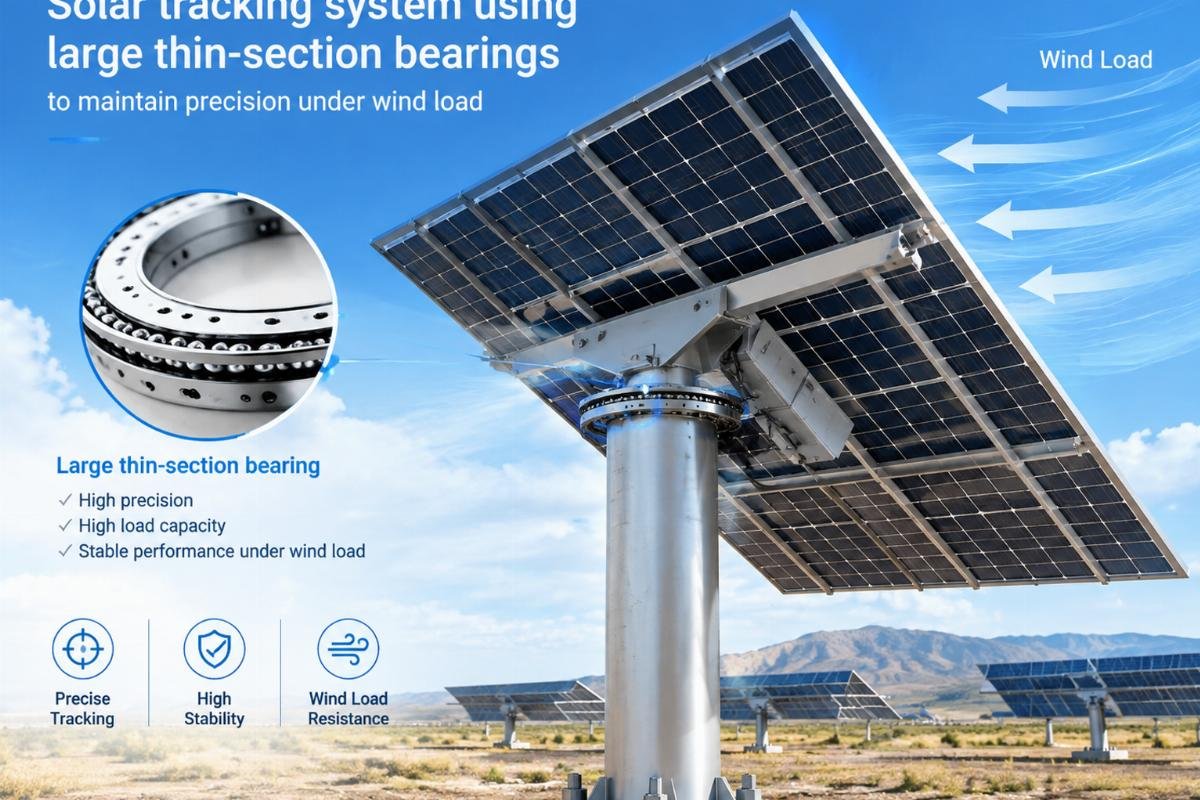
I once consulted for a manufacturer of large-scale solar tracking systems. They initially specified standard industrial bearings for the azimuth drives. The result was significant wobble during high winds, reducing energy capture efficiency. By switching to Kaydon’s large-diameter thin-section bearings with integrated sealing, they achieved the necessary stiffness to maintain panel alignment under wind load, while keeping the drive mechanism compact. This switch was not about strength alone; it was about rigidity per unit of weight. When analyzing FAG vs Kaydon Large Bearings, the question is not which is stronger, but which property—shock tolerance or stiffness—is the limiting factor in your design.
What Happens When You Mismatch Brands to Save Costs?
Using thin-section bearings in heavy shock zones leads to rapid raceway cracking and catastrophic pit halts.
Cost-driven substitution is the most frequent cause of premature bearing failure in heavy industry. Procurement teams often see a Kaydon thin-section bearing with the same bore and outer diameter as a FAG spherical roller and assume it is a viable, cheaper alternative. This is a critical error. Thin-section bearings have significantly less material in the raceways to absorb impact energy. When subjected to the shock loads typical of mining or construction equipment, the Hertzian contact stress exceeds the material’s yield strength, leading to immediate micro-cracking.
I witnessed this firsthand when a mining client replaced a failed FAG unit with a Kaydon equivalent to cut costs. The initial savings were noticeable, but the operational cost skyrocketed within weeks. The Kaydon bearing cracked under the shock loads, causing the crusher shaft to seize. The resulting downtime cost several times the savings from the bearing swap. The teardown revealed classic signs of overload failure: spalling and fracture lines originating from the raceway edges, where the thin section could not distribute the load.
Conversely, using a heavy FAG spherical roller in a precision application can lead to issues with runout and noise. The internal clearance required for misalignment accommodation in FAG bearings introduces play that is unacceptable in high-precision gears or optical systems. This mismatch results in poor product quality and increased wear on mating components due to vibration.
| Mismatch Scenario | Consequence | Root Cause |
|---|---|---|
| Kaydon Thin-Section in High-Shock Zone | Rapid raceway cracking, catastrophic failure | Insufficient material volume to absorb impact energy |
| FAG Spherical Roller in Precision Axis | Excessive runout, noise, reduced positioning accuracy | Internal clearance designed for misalignment, not precision |
| Ignoring Lubrication Requirements | Premature wear, overheating | Different seal designs and grease retention capabilities |
When sourcing FAG vs Kaydon Large Bearings, it is essential to validate the load profile against the bearing’s specific design limits. A lower upfront cost is illusory if it leads to unplanned downtime. The true cost of a bearing includes its service life and the risk of failure, not just the purchase price.

How Can You Build a Mixed-Brand Bearing Package for Optimal ROI?
Strategically pairing FAG for main structural loads and Kaydon for precision auxiliary components maximizes both durability and budget.
The most sophisticated approach to bearing selection is not choosing one brand exclusively, but leveraging the strengths of each where they matter most. In complex machinery, different axes have different requirements. The main slew drive of an excavator, which bears the brunt of digging forces, benefits from the ruggedness of FAG spherical rollers. However, the auxiliary axes, such as the boom cylinder pins or precision sensor mounts, may require the compactness and low friction of Kaydon thin-section or needle roller bearings.
By creating a mixed-brand package, OEMs and MRO operators can optimize both performance and cost. I recently helped a custom machinery builder reduce their overall bill of materials cost by specifying FAG for the high-load main gearbox inputs and Kaydon for the lightweight, high-speed output stages. This strategy ensured that the critical load paths were protected by the most robust technology available, while non-critical, space-constrained areas benefited from the efficiency and compactness of thin-section designs.
This approach requires a deep understanding of the machine’s kinematics and load paths. It is not enough to simply swap parts; one must engineer the solution. Our technical selection support helps clients identify these opportunities, ensuring that every bearing in the assembly is fit for its specific purpose. Whether you need genuine FAG stock for heavy-duty replacements or Kaydon units for precision upgrades, having a supplier who understands the nuance of FAG vs Kaydon Large Bearings is crucial for long-term reliability.

Conclusion
Selecting the right bearing is an engineering decision, not just a purchasing one.
Matching the bearing type to the specific load profile—shock versus precision—is the only way to ensure longevity and performance. FAG provides the ruggedness needed for harsh, high-impact environments, while Kaydon offers the precision and compactness required for sophisticated, space-constrained applications. Avoid the trap of dimensional interchangeability and focus on functional suitability. By strategically combining these brands based on their core strengths, you can achieve optimal reliability and cost-efficiency for your heavy equipment and precision machinery.