Brand loyalty does not prevent mechanical failure. Choosing between FAG and McGill spherical bearings requires matching specific load, speed, and misalignment conditions rather than just comparing brand names. The right selection minimizes downtime in heavy industry, while cross-brand alternatives often provide cost-effective solutions for harsh environments without compromising reliability.
Selecting the correct spherical roller bearing is rarely about picking the most famous logo on the box. It is about understanding the internal geometry that handles misalignment and radial loads. In my early days working at a paper mill in Ho Chi Minh City, I watched a production line halt for three days because a dryer cylinder bearing failed. The maintenance team had installed a standard McGill unit, assuming it would handle the heat. They were wrong. The cage material degraded under sustained high temperatures, leading to catastrophic fragmentation. That incident shifted my focus from simple procurement to technical validation. Now, when clients ask for a FAG vs McGill Spherical Bearings comparison, I do not start with price lists. I start with their operating environment.
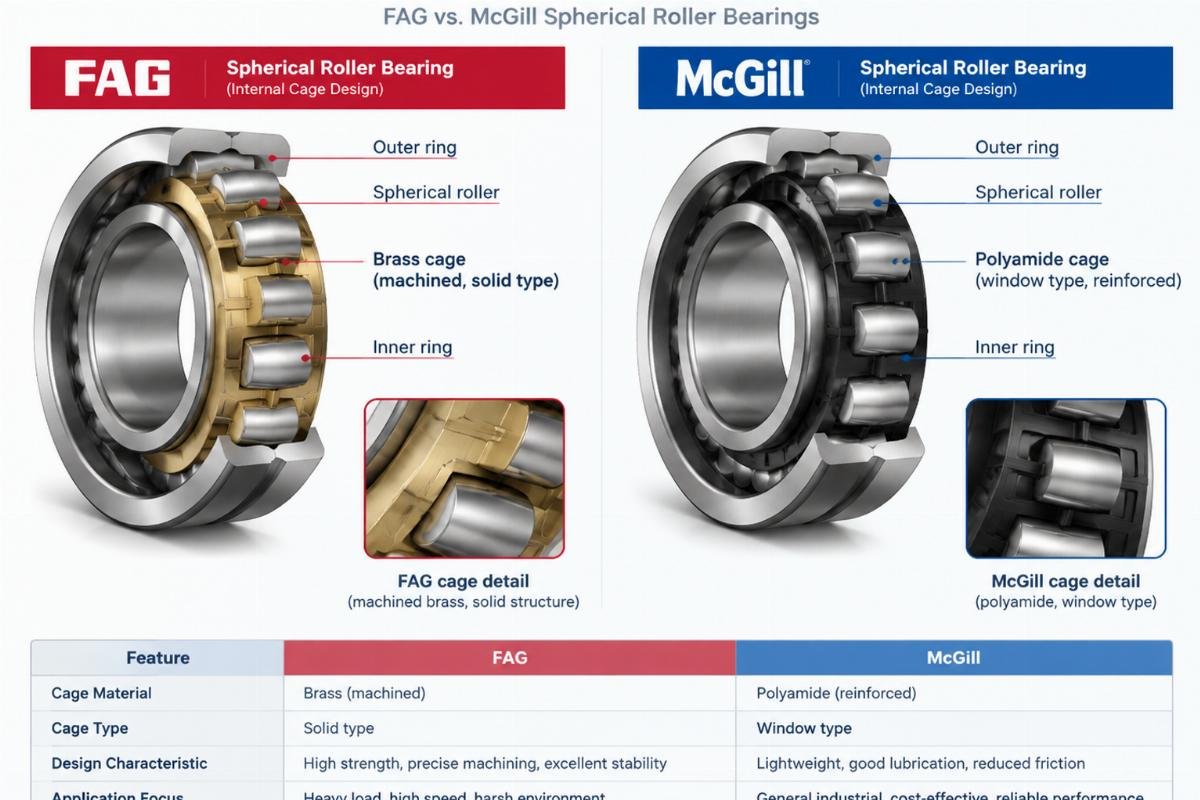
The core difference lies in how each manufacturer approaches internal clearance and cage design. FAG, part of the Schaeffler group, often emphasizes precision grinding and specific cage materials like polyamide or brass depending on the series. McGill, now part of Regal Rexnord, has a strong heritage in heavy-duty applications, particularly in industries like mining and aggregates where shock loads are common. Understanding these nuances is critical for MRO managers and distributors who need to ensure batch consistency and genuine quality.
What Are the Core Structural Differences Between FAG and McGill Spherical Bearings?
Internal design dictates performance under stress. While both brands meet ISO standards for dimensions and load ratings, their approach to cage construction and internal clearance varies significantly. These structural choices determine how the bearing behaves when faced with misalignment or thermal expansion.
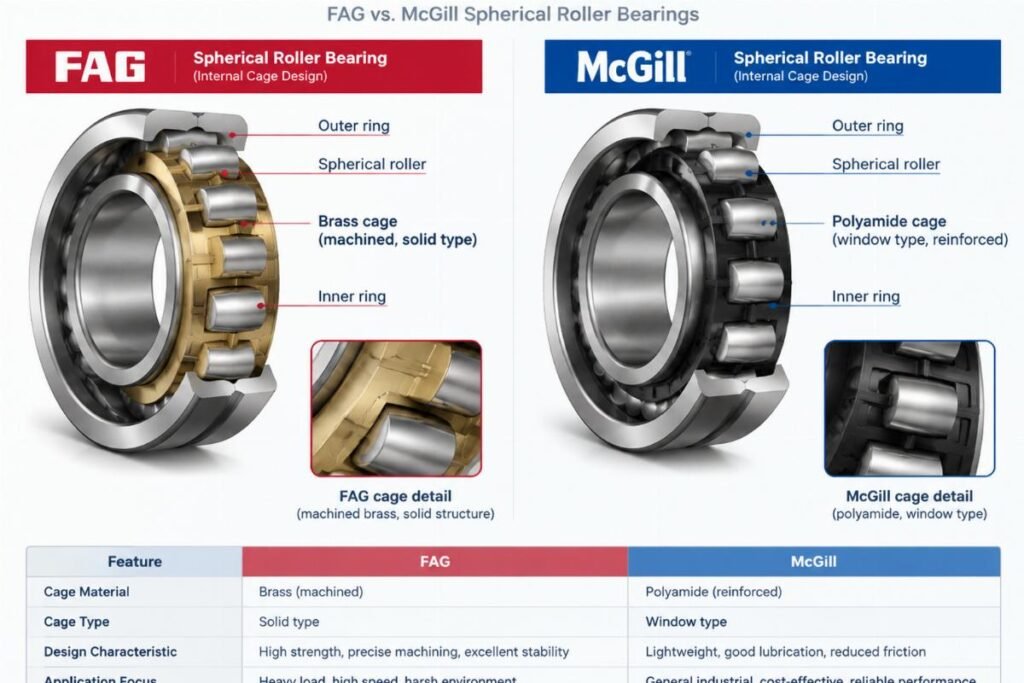
FAG spherical roller bearings typically feature a robust outer ring with a sphered raceway, allowing for self-alignment. Their cage designs often utilize glass-fiber reinforced polyamide for lower friction and higher speed capabilities, or machined brass for heavier loads.. In contrast, McGill bearings are renowned for their durability in slow-speed, high-load scenarios. They frequently employ stamped steel or machined brass cages designed to withstand significant impact forces.
| Feature | FAG Spherical Roller Bearings | McGill Spherical Roller Bearings |
|---|---|---|
| Primary Design Focus | Precision and high-speed capability | Heavy-duty impact resistance |
| Common Cage Material | Polyamide (PA66-GF), Brass | Stamped Steel, Machined Brass |
| Misalignment Tolerance | Standard ISO tolerance | Optimized for severe misalignment |
| Internal Clearance | C3, C4 options widely available | C3, C4, and specialized clearances |
| Typical Application | Paper mills, fans, general machinery | Mining crushers, vibratory screens |
A distributor in Southeast Asia once ordered a bulk shipment of FAG vs McGill Spherical Bearings for a cement plant upgrade. They assumed interchangeability based on outer dimensions alone. However, the FAG units selected had a different internal clearance profile than the original McGill specs. The result was excessive heat generation during the break-in period. This highlights why technical selection support is vital. When sourcing FAG vs McGill Spherical Bearings, one must verify the internal clearance code, such as C3 or C4, to match the shaft and housing fit.
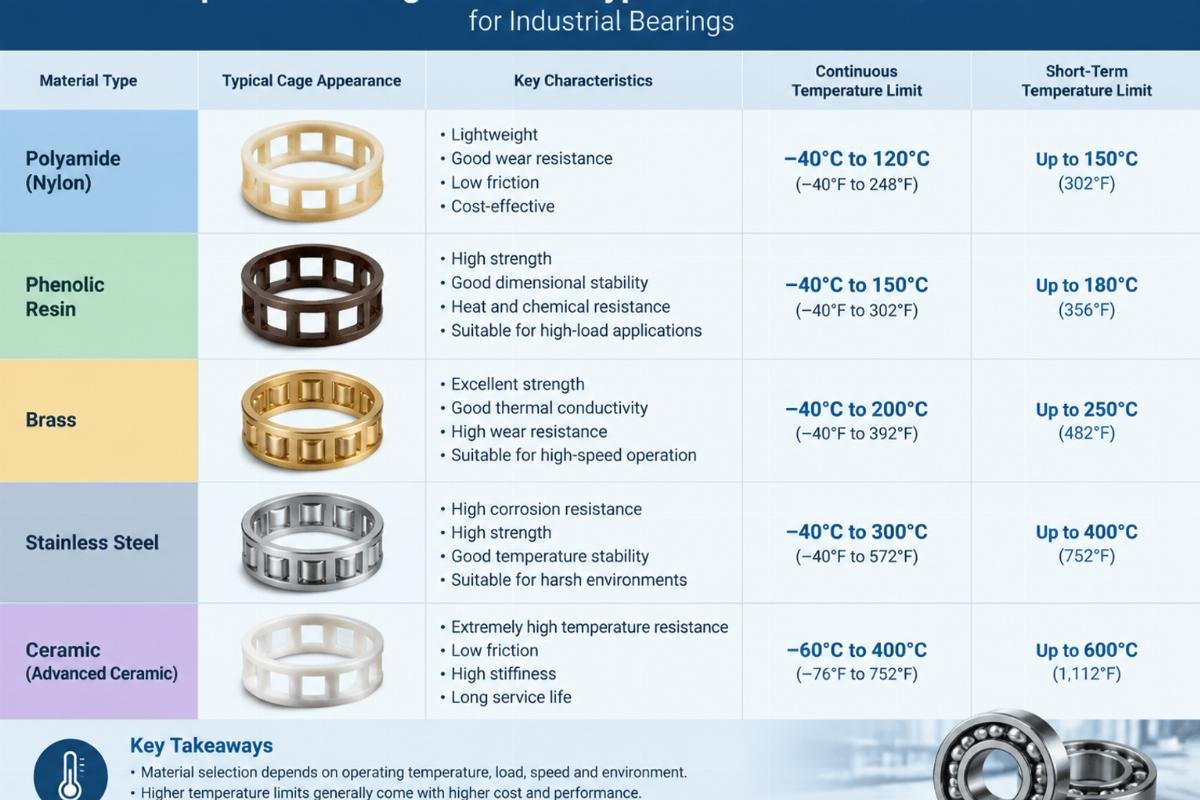
The choice of cage material is not merely a cost decision. Polyamide cages offer weight reduction and better lubrication distribution but have strict temperature limits. Brass cages handle higher temperatures and stresses but are heavier. For a FAG vs McGill Spherical Bearings evaluation, the operating temperature is the deciding factor. If your application involves sustained heat above 120°C, a polyamide cage may fail prematurely, regardless of the brand.
How Do They Perform in High-Temp and Heavy-Load Environments?
Thermal stability is often overlooked until failure occurs. In heavy industries like palm oil processing or steel manufacturing, bearings face extreme radial loads and continuous heat. Performance data shows that brand reputation alone cannot compensate for incorrect specification in these environments.
Consider a palm oil mill vibrator screen. This application subjects bearings to heavy radial loads and constant vibration. A McGill bearing might be specified for its robust cage design, which resists deformation under shock. However, if the internal clearance is too tight, thermal expansion can lead to seizure. Conversely, an FAG bearing with optimized internal geometry might handle the speed better but could suffer from fatigue if the load exceeds its dynamic capacity rating..
In a mining crusher main shaft application, contamination is a major threat. Here, seal efficiency becomes more critical than raw load capacity. Both brands offer sealed variants, but the effectiveness depends on the specific series. A FAG vs McGill Spherical Bearings analysis for this sector must include an assessment of the sealing system. Some McGill units use heavy-duty contact seals that excel in dirty environments, while certain FAG series utilize non-contact seals to reduce friction at higher speeds.

I recall a case involving a mining operation in Indonesia. The site manager insisted on using only one brand due to corporate policy. When supply chain issues delayed shipments, they considered switching. By analyzing the load profiles and contamination levels, we identified a cross-brand equivalent that matched the original specifications precisely. The switch prevented months of downtime. This experience underscores that a FAG vs McGill Spherical Bearings decision should be flexible, prioritizing technical fit over rigid brand loyalty.
For high-temperature applications, such as paper mill dryer cylinders, the cage material is the weak link. As seen in my earlier experience, standard cages can degrade. Both manufacturers offer high-temperature variants, but availability varies by region. Sourcing FAG vs McGill Spherical Bearings for such critical roles requires verifying the exact material grade and thermal rating from the manufacturer’s documentation.
When Should You Consider Cross-Brand Alternatives?
Cost-effectiveness does not mean compromising quality. In many standard replacement scenarios, cross-brand equivalents offer a viable alternative to premium brands like FAG or McGill. This is particularly true for distributors managing inventory costs or end-users facing budget constraints.
The key is to identify applications where the extreme proprietary features of a top-tier brand are not utilized. For example, in a general conveyor system with moderate loads and speeds, a high-quality domestic Chinese bearing from brands like ZWZ, HRB, or LYC can perform reliably. These manufacturers have improved their quality control significantly, meeting ISO standards for many standard applications..
When evaluating FAG vs McGill Spherical Bearings against alternatives, consider the following factors:
- Load Conditions: Is the load steady or shock-heavy?
- Speed: Is the application high-speed or low-speed?
- Environment: Is there contamination or extreme heat?
- Criticality: How costly is unplanned downtime?
If the application is non-critical and operates within standard parameters, a cross-brand alternative can reduce costs noticeably. However, for critical machinery like wind turbine gearboxes or high-speed paper machines, sticking to premium brands is advisable. The risk of failure outweighs the initial savings.
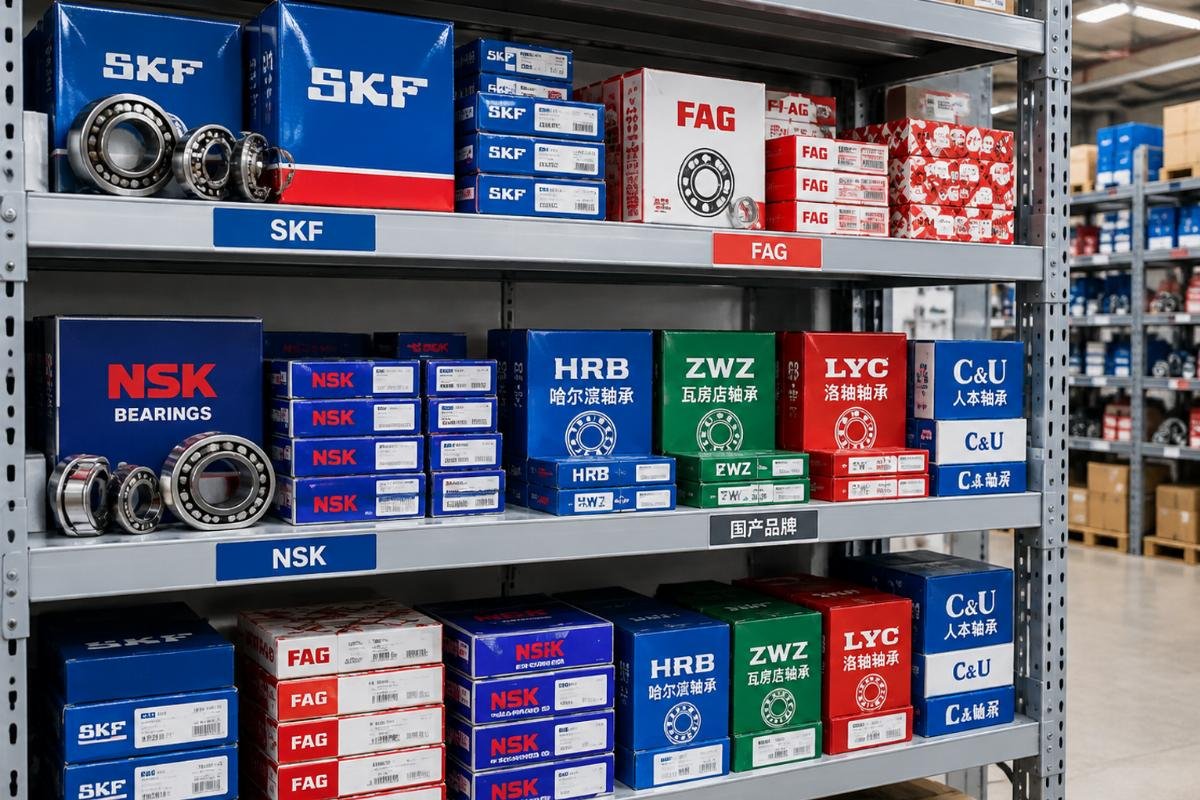
A European wind farm operator once faced long lead times for specific McGill replacements. By consulting with technical experts, they identified an equivalent from another premium brand that met all dimensional and load requirements. The transition was smooth, and the bearings performed as expected. This demonstrates that a FAG vs McGill Spherical Bearings comparison should include other reputable brands in the decision matrix.
For distributors, offering cross-brand alternatives expands market reach. Clients in emerging markets often seek reliable yet affordable options. Providing genuine alternatives alongside premium brands like FAG and McGill allows for a more comprehensive service. Sourcing FAG vs McGill Spherical Bearings and their equivalents requires a supplier with deep technical knowledge and access to diverse product lines.
How to Verify Quality and Avoid Counterfeits in Bulk Orders?
Traceability is the only defense against counterfeits. The global bearing market is flooded with fake products that look identical to genuine items but lack the metallurgical quality and precision. For bulk orders, verifying authenticity is non-negotiable.
Counterfeit bearings often use inferior steel with higher inclusion densities, leading to premature fatigue failure. They may also have incorrect internal clearances or poor surface finishes.. To avoid these risks, buyers must demand complete traceability documentation. This includes original packaging, batch numbers, and certificates of conformity.
When sourcing FAG vs McGill Spherical Bearings, check for the following:
- Packaging: Genuine products have high-quality printing and specific security features.
- Markings: Laser etching or stamping should be clear and consistent.
- Documentation: Request test reports or material certificates for large orders.
- Supplier Reputation: Work with authorized distributors or reputable global suppliers.
A Middle East steel mill once received a container of bearings that appeared genuine. However, upon installation, several units failed within weeks. Investigation revealed they were counterfeits with poor heat treatment. The loss was substantial, not just in parts but in production downtime. This incident highlights the importance of rigorous verification when purchasing FAG vs McGill Spherical Bearings.

Reliable suppliers provide mixed-brand consolidation services, allowing buyers to source FAG, McGill, and other brands in a single shipment. This reduces logistics costs and simplifies inventory management. However, it also increases the risk of mixing genuine and fake products if the supplier is not trustworthy. Therefore, choosing a partner with a proven track record in genuine sourcing is essential.
For MRO managers, maintaining a list of approved suppliers is crucial. Regular audits and sample testing can help ensure ongoing quality. When comparing FAG vs McGill Spherical Bearings, the assurance of genuineness is as important as the technical specifications. A slightly higher price from a verified supplier is often cheaper than the cost of a single failure.
Conclusion
Technical fit outweighs brand name. Selecting between FAG and McGill spherical bearings requires a deep understanding of application conditions, not just marketing claims. Cross-brand alternatives offer viable options for less critical applications, provided they meet ISO standards.
Verify authenticity through traceability and work with reputable suppliers to avoid counterfeits. Proper selection and genuine sourcing minimize downtime and ensure operational efficiency in heavy industry.