NSK is not always a direct drop-in replacement for FAG in high-temperature pump applications.
Selecting between FAG and NSK bearings for US pumps requires matching exact operational realities like temperature and internal clearance, rather than relying solely on basic dimensions or upfront price. Premature failure often stems from unverified clearance classes under thermal stress, not brand inferiority.
I still recall the humidity and heat of a desalination plant project in Riyadh. A client decided to swap specified FAG bearings for NSK units to reduce initial procurement costs. The dimensional specifications matched perfectly on paper. However, I failed to double-check the internal clearance requirements for their specific high-temperature operating setup. The result was catastrophic. The NSK units failed within weeks due to excessive preload caused by thermal expansion, while the original FAG specification had accounted for this with a different clearance class. The client was furious, and the replacement cost far exceeded the initial savings. That incident reshaped my approach. Comparing FAG and NSK bearings for US pumps is not merely about choosing a brand; it is about verifying that the bearing’s internal geometry matches the pump’s thermal and mechanical environment.

Understanding these nuances is critical for MRO operators and OEMs who need reliable cross-brand alternatives without risking unplanned downtime. Let us explore how to make these decisions correctly.
Why Basic Dimensions Aren’t Enough for Pump Bearings?
Internal clearance and thermal expansion dictate real compatibility, not just outer diameter and bore size.
Many buyers assume that if two bearings share the same ISO boundary dimensions, they are interchangeable. This is a dangerous oversimplification. While FAG and NSK both adhere to international standards for boundary dimensions, their default internal clearance offerings and design philosophies for specific applications can differ significantly.
In pump applications, especially those handling hot fluids or operating in warm environments, the shaft expands more than the housing. If the bearing has insufficient internal clearance, this differential expansion eliminates the running gap, creating excessive preload. This preload generates heat, which causes further expansion, leading to a thermal runaway scenario that destroys the bearing in a short time.
Consider a case involving a chemical transfer pump in a US refinery. The maintenance team replaced a worn FAG angular contact ball bearing with an NSK equivalent based on part number similarity. However, the FAG unit had been selected with a specific preload setting for vibration control, while the NSK unit had a standard clearance. The mismatch led to increased vibration amplitude, causing seal failure and fluid leakage. The issue was not the quality of the NSK bearing, but the mismatch in operational parameters.
| Feature | Standard Industrial Practice | High-Temp Pump Requirement |
|---|---|---|
| Internal Clearance | Standard (C3) | Verified Thermal Expansion Allowance |
| Preload Setting | Manufacturer Default | Application-Specific Calculation |
| Lubrication | General Purpose | High-Temperature Stable Grease |
| Failure Mode | Gradual Wear | Sudden Thermal Seizure |
When evaluating FAG vs NSK bearings for US pumps, always request the technical datasheet for the specific batch. Verify the clearance class (e.g., C3, C4) and ensure it aligns with the pump’s operating temperature range. Do not assume that a “standard” offering from one brand matches the “standard” of another in critical applications.

FAG vs. NSK: How Do Their High-Temp Tolerances Compare?
Brand-specific design philosophies affect performance under thermal stress, requiring careful selection.
Both FAG and NSK are premium manufacturers with robust engineering capabilities. However, their approaches to high-temperature tolerance can vary based on material treatments and cage designs. FAG, part of the Schaeffler group, often emphasizes high-purity steel and specialized heat treatment processes for its industrial lines. NSK focuses heavily on material technology as well, with proprietary developments in long-life steel.
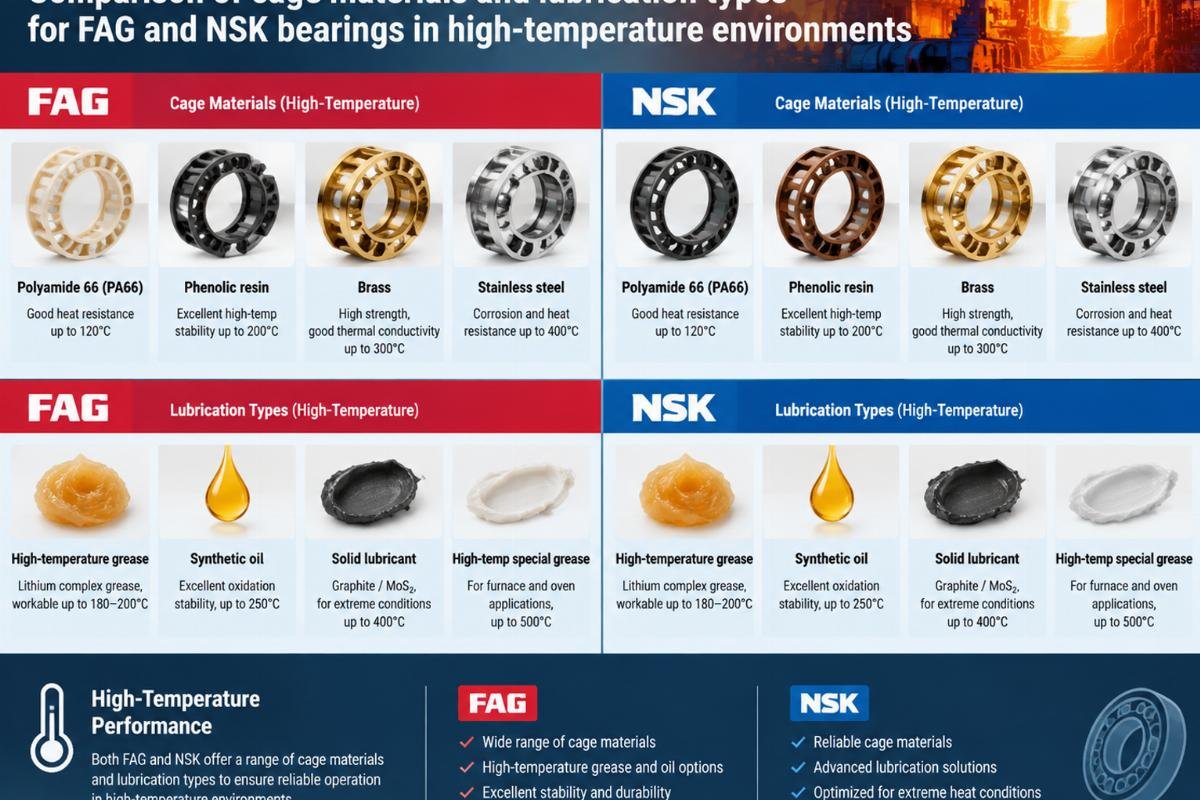
In high-temperature pump scenarios, the limiting factor is often not the steel itself, but the cage material and lubricant stability. Polymer cages may have lower temperature limits than brass or steel cages. If a FAG bearing uses a polyamide cage and the NSK alternative uses brass, the thermal limits differ significantly. Swapping them without checking this detail can lead to cage deformation and failure.
A municipal water pump operator once sought to reduce costs by switching from FAG to NSK for a series of large vertical turbines. The initial price difference was attractive. However, the FAG units used a specific high-temperature grease compatible with their brass cages, while the NSK units supplied had a different standard lubrication. Under continuous operation at elevated temperatures, the lubricant in the NSK units degraded faster, leading to increased friction and noise. The lifecycle cost analysis over five years showed that the maintenance frequency increased substantially, erasing any initial savings.
When comparing FAG and NSK bearings for US pumps, look beyond the brand name. Examine the cage material, the lubricant type, and the specified operating temperature range in the datasheet. Ensure that the alternative bearing meets or exceeds the thermal requirements of the original specification.
What Are the Hidden Costs of Cross-Brand Swapping?
Ignoring operational realities leads to catastrophic lifecycle costs, far exceeding initial purchase savings.
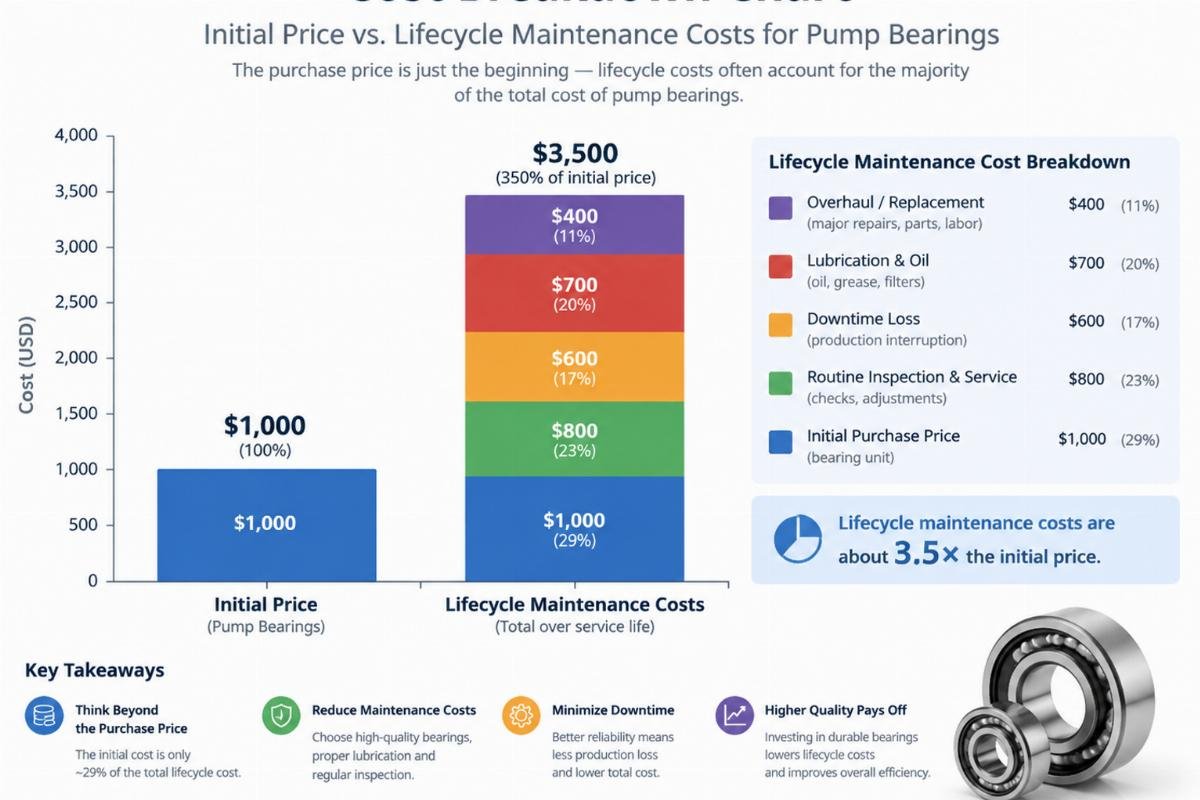
The temptation to switch brands for a lower upfront price is strong. However, in industrial pump applications, the cost of the bearing is a tiny fraction of the total cost of ownership. The real expenses lie in installation labor, downtime, lost production, and collateral damage to seals and shafts.
Unplanned downtime is exponentially more expensive than planned maintenance. If a bearing fails prematurely due to a mismatched clearance or lubrication issue, the pump must be taken offline immediately. This disrupts processes, potentially halting entire production lines. In sectors like oil and gas or water treatment, such interruptions can have severe financial and regulatory consequences.
Consider a scenario where a manufacturing plant switched to a cheaper alternative for a critical coolant pump. The bearing failed after only a few months, causing the pump shaft to seize. The resulting damage required replacing not just the bearing, but also the mechanical seal and the shaft itself. The total repair cost was several times the price difference saved on the bearing. Moreover, the unplanned shutdown delayed a major production batch, leading to missed deadlines and penalty clauses.
When evaluating FAG vs NSK bearings for US pumps, calculate the total lifecycle cost. Include the frequency of maintenance, the expected service life under specific conditions, and the potential cost of downtime. A slightly more expensive bearing that lasts twice as long and prevents unplanned stops is often the more economical choice.
How to Verify Bearing Suitability Before Ordering?
Always request technical datasheets and verify clearance classes to ensure compatibility.
Before placing an order for a cross-brand alternative, take proactive steps to verify suitability. Do not rely solely on part number cross-references provided by online databases, as these may not account for specific suffixes indicating clearance, preload, or material variations.
First, obtain the original bearing’s full part number, including all suffixes. Decode these suffixes to understand the internal clearance, cage type, and lubrication. Then, request the technical datasheet for the proposed alternative from the supplier. Compare the key parameters: internal clearance, limiting speed, load ratings, and operating temperature range.
Second, consult with a technical expert who understands pump applications. A knowledgeable supplier can help interpret the datasheets and identify potential mismatches. For instance, they can advise if a specific NSK clearance class is equivalent to the FAG class required for your temperature conditions.
Third, consider ordering a small sample batch for testing before committing to a full replacement. Install the sample bearings in non-critical pumps first and monitor their performance. Check for vibration levels, temperature rise, and noise. This practical validation can prevent large-scale failures.
Finally, ensure traceability. Genuine bearings come with proper documentation and packaging. Counterfeit or mislabeled products can slip into the supply chain, posing significant risks. Work with suppliers who provide verifiable proof of origin and maintain strict quality control.

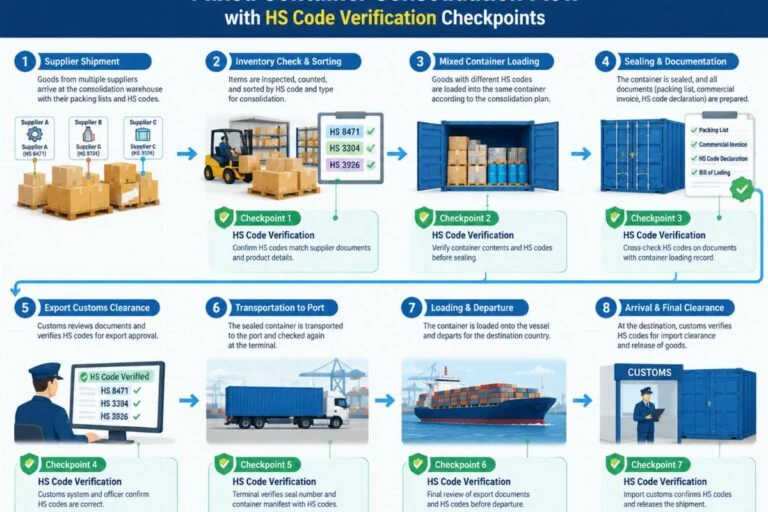
Our approach to supplying FAG vs NSK bearings for US pumps involves rigorous technical consultation. We do not just ship boxes; we verify that the technical specifications match your operational needs. By offering cross-brand technical support and genuine traceability, we help you avoid the pitfalls of improper substitution. Whether you need a single emergency spare or a consolidated container of mixed brands, our focus is on ensuring reliability and minimizing your total cost of ownership.
Conclusion
Matching operational reality is more critical than brand loyalty or initial price.
Choosing between FAG and NSK for pump applications demands a deep understanding of internal clearance, thermal expansion, and lubrication compatibility. Blindly swapping brands based on dimensions alone invites premature failure and costly downtime. By verifying technical datasheets and considering lifecycle costs, you can make informed decisions that enhance reliability and efficiency.