

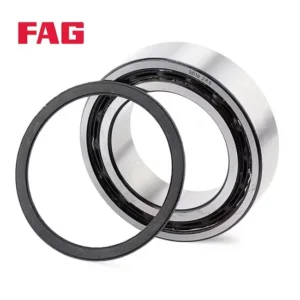
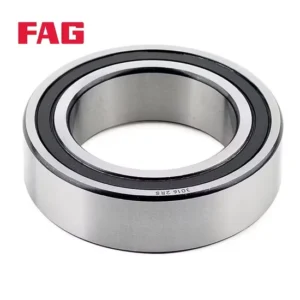
Product details
Description and application notes
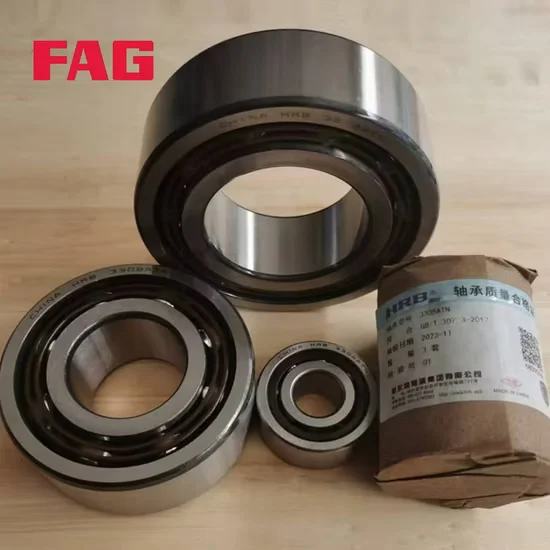
Verified via official app — Every FAG 3206da double row angular contact ball bearing ships with a scannable QR code linking directly to the manufacturer's authentication database.
Technical Specifications
| Parameter | Value |
|---|---|
| Designation | FAG 3206da |
| Bearing Type | Double Row Angular Contact Ball Bearing |
| Contact Angle | 45° (Da Type) |
| Aligning | Non-Aligning |
| Separated | Separated |
| Rows Number | Double |
| Material | Bearing Steel |
| Cage Options | Polyamide (Tvh), Sheet Steel, Brass (MP) |
| Seal Type Options | Open, 2Z, 2HRS |
| Precision Class | P0, P6, P5 |
| Origin | Jiangsu, China |
| Standards | DIN 628-3, ISO 15:2017 |
Application Suitability
| Industry | Typical Applications |
|---|---|
| Machine Tool Manufacturing | High-speed spindle assemblies requiring rigid axial support |
| Fluid Handling | High-speed pumps managing combined radial and thrust loads |
| Automation & Robotics | Precision rotary joints and articulated arm pivots |
| General Industrial | Gearboxes and precision equipment needing high axial capacity |
Maximizing Axial Rigidity with the FAG 3206da double row angular contact ball bearing in High-Thrust Spindles
The steeper 45° contact angle optimizes axial load distribution, preventing raceway edge-stressing under heavy thrust conditions.
In Dubai's extreme ambient heat, I once watched a standard 3206 bearing seize inside a machine tool spindle because thermal expansion eliminated the internal clearance entirely. When massive axial loads compound with rapid thermal growth, standard contact angles simply cannot dissipate the localized stress, leading to catastrophic raceway smearing and immediate seizure. Selecting the correct contact angle and clearance pairing is not just a catalog exercise; it is the primary defense against unplanned downtime in demanding precision environments.
Matching Cage Materials to Spindle Speed Profiles
Selecting the right cage for a FAG 3206da double row angular contact ball bearing dictates its thermal stability and structural integrity at high RPMs. Polyamide (Tvh) cages offer exceptionally low friction for continuous high-speed operation, minimizing heat generation inside the spindle housing. Conversely, brass (MP) cages provide superior durability and heat dissipation under heavy vibration, shock loads, or marginal lubrication conditions. Our engineering team cross-references your specific speed, load, and temperature profiles to recommend the optimal cage variant, ensuring the bearing survives the actual operating envelope rather than just the theoretical catalog limits.
Managing Thermal Expansion and Lubrication Breakdown
High-speed precision equipment generates immense internal friction, rapidly elevating local temperatures and degrading standard lubricants before they can protect the rolling elements. If the internal clearance class is not carefully matched to this thermal growth, the balls will skid across the raceways, destroying the mirror finish and initiating spalling. Furthermore, open bearings require highly controlled external oil-air lubrication systems to manage heat, whereas sealed variants (2Z or 2HRS) effectively trap contaminants but introduce contact friction that inherently limits top speed. Understanding these critical trade-offs is mandatory before finalizing the seal and clearance configuration for your specific machinery.
Decoding the "da" Suffix and Precision Tolerances
The "da" suffix specifically denotes a 45° contact angle, engineered explicitly to handle predominantly axial loads or heavy combined loads where the thrust component heavily dominates the radial forces. Unlike standard 30° variants, this steeper angle intentionally sacrifices some radial capacity to maximize axial rigidity, making it absolutely indispensable for vertical pump shafts or heavily preloaded spindle arrangements. Additionally, choosing between P0, P6, and P5 precision classes directly impacts the running accuracy and vibration levels of the assembled machinery. A P5 class ensures much tighter dimensional tolerances, which is strictly mandatory for minimizing runout and maintaining surface finish quality in high-precision machining centers.
The Financial Toll of Ignoring Clearance and Contact Angle Alignment
Specifying an incorrect contact angle or ignoring thermal clearance requirements inevitably triggers severe unplanned downtime and premature mechanical failure. When a bearing designed primarily for radial loads is subjected to heavy axial thrust, the contact ellipse shifts dangerously outside the raceway shoulder, causing severe edge-loading and rapid fatigue. This catastrophic damage not only destroys the bearing itself but often scores the expensive spindle shaft, voiding the machine tool warranty and forcing a complete, highly expensive assembly rebuild that halts production for weeks.
Securing Traceability and Technical Alignment for Precision Bearings
Sourcing a genuine FAG 3206da double row angular contact ball bearing requires much more than just checking a part number; it demands rigorous supply chain verification and technical oversight.
- We provide complete origin documentation, ensuring the declared manufacturing facility matches the official brand registry without exception.
- Our technical team cross-checks the "da" suffix and precision class against your OEM drawings to prevent the costly mistake of substituting a standard 30° variant.
- We supply detailed dimensional and running accuracy inspection reports, confirming the P5 or P6 tolerances before the components leave our warehouse.
- For mixed-brand consolidation projects, we align equivalent models across premium manufacturers to maintain uniform performance across your entire fleet.
- Every single shipment includes factory batch traceability, allowing you to track the exact production run for future maintenance scheduling.
Documentation & Authenticity
- Certificate of Conformity verifying the specific P0, P6, or P5 precision class of your order.
- Scannable QR codes on packaging linking directly to the official manufacturer authentication database.
- Dimensional inspection reports confirming the 45° contact angle and bore tolerances before dispatch.
- Factory batch traceability documents detailing the exact production date and origin facility in Jiangsu.
- Material test certificates validating the metallurgical composition of the bearing steel rings and rolling elements.
Storage, Handling & Mounting
- Store open-type variants in original anti-corrosion packaging until mounting to prevent humidity ingress on precision raceways.
- Use clean, lint-free gloves when handling brass (MP) cages to avoid skin oils degrading the material.
- For sealed 2Z or 2HRS units, do not wash or re-lubricate, preserving factory grease and seal integrity.
- Maintain strict storage temperature control to prevent thermal shock altering the micro-geometry of P5 precision rings.
- During mounting of separated units, align rings perfectly to avoid brinelling the 45° raceway shoulders during press-fitting.
Engineering Review for Optimal Spindle Configuration
To ensure the selected configuration survives your specific operating envelope, please share your detailed radial and axial load profiles, maximum operating speeds, and expected thermal gradients. Providing the exact OEM equipment model number allows our engineering team to perform a comprehensive cross-reference check and verify the L10 life calculation under your exact conditions. If your application involves extreme contamination, heavy shock loads, or severe temperature fluctuations, specify these environmental factors so we can recommend the most appropriate seal type, cage material, and clearance class for maximum reliability.
Frequently Asked Questions
Q: What does the "da" suffix indicate on this specific angular contact bearing?
A: The "da" suffix designates a 45° contact angle, which optimizes the bearing for heavy axial loads and combined loads where thrust dominates. Unlike standard 30° versions, this steeper angle provides superior axial rigidity, making it ideal for vertical shafts and high-thrust machine tool spindles requiring maximum directional stability.
Q: How do I choose between Polyamide, Sheet Steel, and Brass cages?
A: Polyamide (Tvh) cages are ideal for high-speed, low-friction applications, while sheet steel offers a balanced cost-to-performance ratio for standard speeds. Brass (MP) cages are mandatory for environments with high vibration, shock loads, or elevated temperatures where polymer cages might degrade. We evaluate your specific RPM and thermal data to recommend the exact match.
Q: What precision classes are available, and how do they affect performance?
A: This model is available in P0, P6, and P5 precision classes. While P0 suits general industrial gearboxes, P6 and P5 are strictly required for machine tool spindles and precision robotics. Higher precision classes guarantee tighter dimensional tolerances and reduced runout, directly minimizing vibration and extending the operational life of high-speed assemblies.
Q: How can I verify the authenticity of the bearings upon delivery?
A: Every shipment includes scannable QR codes on the packaging that link directly to the official manufacturer authentication app. Additionally, we provide a Certificate of Conformity and factory batch traceability documents, allowing you to cross-check the origin, production date, and precision class against the official supply chain registry.
Q: Are these bearings separable, and how does that impact installation?
A: Yes, the inner ring with the ball and cage assembly can be separated from the outer ring. This separable design significantly simplifies the mounting process, allowing you to press-fit the inner and outer rings independently without inducing damaging axial loads across the 45° contact angle raceways during installation.