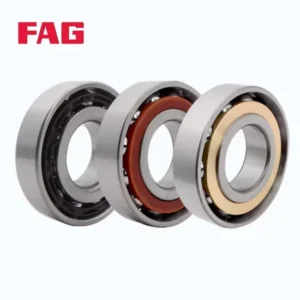
Product details
Description and application notes
Unified Multi-Brand Sourcing — Consolidate your FAG and SKF orders into a single shipment without juggling multiple vendor accounts.
Technical Specifications
| Parameter | Value |
|---|---|
| Designation | 3308-Bd-XL-Tvh-L285-C3 FAG |
| Bearing Type | Double Row Angular Contact Ball Bearing |
| Contact Angle | α=30° |
| Cage Material | Polyamide (Tvh) |
| Seal or Shield Type | Open |
| Clearance Class | C3 |
| Precision Class | P0 / P6 / P5 |
| Rows Number | Double |
| Material | Bearing Steel |
| Standard | DIN 628-3, ISO 15:2017 |
| Origin | Jiangsu China |
Note: XL and L285 are unverified suffixes requiring manufacturer catalog confirmation.
Application Suitability
| Industry | Typical Applications |
|---|---|
| Machine Tool Manufacturing | High-speed spindle assemblies requiring precise radial and axial rigidity |
| Fluid Handling Systems | High-temperature pump shafts experiencing thermal expansion |
| Industrial Automation | Robotic joint actuators demanding low-friction rotational accuracy |
Why Thermal Expansion Destroys Standard Clearance in the FAG 3308-Bd-XL-Tvh-L285-C3 double row angular contact ball bearing
Selecting the correct internal clearance prevents catastrophic seizure when operating temperatures rise.
During my early failure analysis days in Dubai, I dismantled a seized high-temperature water injection pump that had completely locked up on a critical production line. The maintenance team had installed a standard CN clearance bearing, entirely ignoring the extreme Middle Eastern ambient heat combined with intense operational friction from the pumping mechanism. The thermal expansion eliminated the internal clearance entirely, causing the rolling elements to bind and ultimately leading to a complete mechanical lock-up within just a few months of service. Specifying a C3 clearance class is not merely a catalog preference or an arbitrary suffix choice; it is a critical survival requirement for hot-running machinery where differential expansion rates between the shaft and housing dictate the operational lifespan. Understanding these thermal dynamics is the difference between a reliable production cycle and an unexpected mid-shift breakdown.
Matching the 30° Contact Angle to Combined Loads
When dealing with complex combined radial and axial forces in precision machinery, the optimized 30° contact angle of this FAG 3308-Bd-XL-Tvh-L285-C3 double row angular contact ball bearing provides a highly balanced load distribution across both rows of rolling elements. Our engineering team frequently cross-references these specific angular contact geometries against original equipment manufacturer specifications to ensure the axial thrust capacity aligns perfectly with the machine's operational profile. This precise matching prevents premature raceway spalling and ensures that the bearing can handle the simultaneous pushing and rotational forces typical in high-speed fluid handling systems without compromising the structural integrity of the inner and outer rings.
Managing High-Speed Friction and Thermal Shifts
In high-speed pump and precision spindle applications, continuous friction generates substantial heat, which directly impacts the lubricant film thickness and the internal geometry of the assembly. An open bearing design allows for customized oil-air or oil-mist lubrication systems to effectively flush away heat and wear particles, while the lightweight polyamide cage minimizes inertial forces and friction at elevated rotational speeds. If the operating environment introduces fine particulate contamination, external non-contact sealing solutions must be carefully integrated to protect the raceways without inducing excessive contact friction that would otherwise generate even more heat. Balancing these thermal and frictional variables is essential for maintaining the dimensional stability of the bearing under continuous operational stress.
Decoding the Cage and Clearance Synergy
The polyamide (Tvh) cage significantly reduces overall weight and friction compared to traditional machined brass alternatives, enabling smoother high-speed operation and remarkably quieter running characteristics. However, polymer cages have strict thermal limits, making the C3 internal clearance absolutely essential to accommodate the differential thermal expansion between the inner and outer rings during prolonged operation. The 30° contact angle (Bd type) further ensures that axial loads are carried efficiently without over-stressing the rolling elements, maintaining strict precision across P0 to P5 tolerance classes. This integrated design allows the bearing to absorb axial thrust while the expanded clearance prevents the polyamide cage from deforming or melting under the compounded thermal and mechanical loads experienced in demanding industrial environments.
The Financial Impact of Incorrect Clearance Selection
Ignoring the thermal dynamics of your specific application and defaulting to standard clearance inevitably leads to severe unplanned downtime and catastrophic damage to the surrounding shaft and housing components. According to failure mode classifications outlined in ISO 15243, excessive preload generated by unchecked thermal expansion causes severe smearing, raceway discoloration, and eventual cage fragmentation. Replacing a seized bearing is merely the beginning of the repair process; the secondary damage to precision machined spindles and pump shafts often results in complete warranty voidance and extended production halts that far exceed the cost of the initial component. Proactively addressing these clearance requirements protects your capital equipment from cascading mechanical failures.
Securing Authenticity and Technical Alignment
Sourcing genuine components is absolutely critical, as counterfeit bearings frequently fail to meet the precise metallurgical and dimensional standards required to maintain the C3 clearance and polyamide cage integrity under load. We provide complete traceability documentation for every 3308-Bd-XL-Tvh-L285-C3 FAG, ensuring the internal geometry and material composition match the original equipment manufacturer's exact demands. Our technical team actively verifies cross-reference equivalencies and meticulously checks clearance suffixes to prevent the exact misapplication issues I witnessed in the field, backed by flexible consolidation shipping for mixed-brand project orders. This rigorous validation process guarantees that you receive a component capable of surviving your specific thermal and mechanical environment, rather than a generic substitute that will fail prematurely.
Documentation & Authenticity
- Certificate of Conformity verifying the original manufacturer's production facilities and batch numbers.
- Official app QR code scanning support to validate the authenticity of the polyamide cage and rings.
- Dimensional and running accuracy inspection reports confirming P0, P6, or P5 tolerances before dispatch.
- Material test certificates ensuring the bearing steel meets standard metallurgical requirements for high-speed spindles.
Storage, Handling & Mounting
- Store the open bearing in its original packaging to prevent particulate contamination from entering the polyamide cage pockets.
- Maintain a stable storage temperature to avoid condensation, which can cause micro-corrosion on the precision ground raceways.
- Use clean, lint-free gloves during handling to prevent skin acids from degrading the raceway surfaces before mounting.
- Apply the specified high-speed spindle oil immediately after unsealing, as the open design lacks factory-applied grease.
- Verify the shaft and housing tolerances to ensure the C3 internal clearance is not compromised by excessive interference fits.
Preparing Your Technical Parameters for Review
To ensure optimal selection and prevent costly misapplications, please share your specific radial and axial load profiles, maximum operating speeds, and anticipated thermal gradients across the shaft and housing. Providing the original equipment manufacturer's part number allows our engineering team to perform a precise cross-reference check and verify the L10 life calculation under your exact operating conditions. This detailed operational data enables us to definitively confirm whether the C3 clearance and polyamide cage configuration perfectly match your machinery's demands, or if an alternative material or sealing arrangement is necessary to achieve your target maintenance intervals.
Frequently Asked Questions
Q: How can I verify the authenticity of the polyamide cage and C3 clearance?
A: You can validate the component by scanning the official QR code on the packaging using the manufacturer's verification app. Additionally, we supply a Certificate of Conformity and dimensional inspection reports that explicitly confirm the C3 internal clearance and Tvh cage specifications, ensuring complete traceability from the original production batch.
Q: What cross-reference factors matter when replacing standard 33 series bearings?
A: When replacing older variants, you must align the contact angle, cage material, and internal clearance. A standard CN clearance bearing will fail in high-heat environments where a C3 class is required. Our team cross-references these specific suffix combinations against equivalent models to guarantee the axial load capacity and thermal expansion tolerances remain intact.
Q: How does the C3 clearance differ from standard CN in high-temperature pumps?
A: Standard CN clearance is designed for normal ambient temperatures, whereas C3 provides greater internal space to accommodate thermal expansion of the steel rings and shaft. In high-temperature pump applications, this extra clearance prevents the rolling elements from seizing when the inner ring expands faster than the outer ring due to operational heat.
Q: What are the speed limitations of the polyamide cage compared to brass?
A: Polyamide cages are significantly lighter, reducing centrifugal forces and allowing for higher limiting speeds with lower friction. However, they have stricter upper temperature thresholds than machined brass cages. If your application exceeds the thermal limits of the polymer, a brass-caged alternative must be evaluated to maintain structural integrity at elevated temperatures.
Q: Which lubrication methods are recommended for this open bearing design?
A: Since the bearing is open, it relies entirely on external lubrication systems. For high-speed machine tool spindles, oil-air or oil-mist lubrication is typically recommended to provide continuous cooling and minimal churning losses. The specific oil viscosity and feed rate should be calculated based on your exact rotational speed and operating temperature to ensure adequate film thickness.