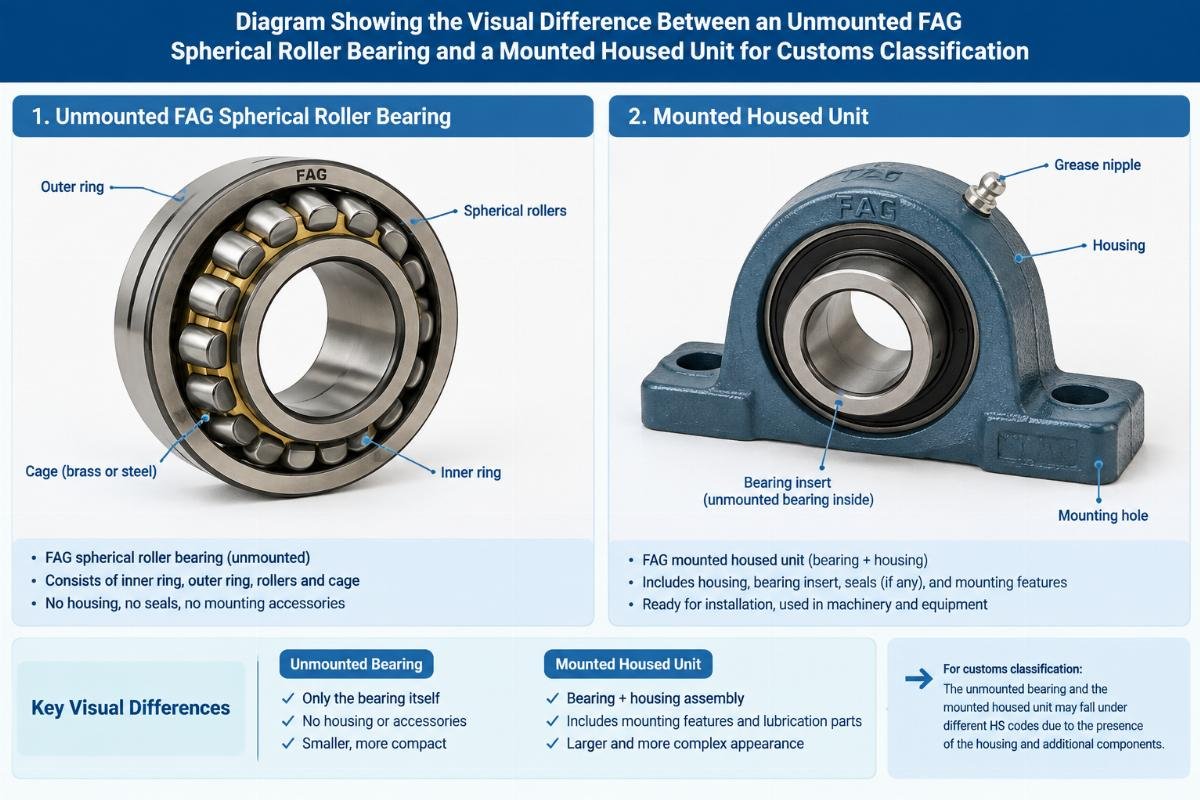
The mounting state changes the code entirely.
Accurate HTS codes for FAG bearing types depend on whether the unit is mounted or unmounted, and whether it uses balls or rollers. Misclassifying a housed spherical roller bearing as a bare component triggers customs holds, demurrage fees, and incorrect duty assessments. The correct classification requires matching the physical assembly status to the specific subheading under HS Chapter 84, not just relying on the brand name or general bearing category.
I still remember the humidity at the Santos port in Brazil, standing next to a shipping container that had been sitting there for weeks. Inside were thousands of FAG spherical roller bearings intended for a mining crusher overhaul. The paperwork looked perfect to the naked eye, but the local customs broker shook his head. The HTS code listed on the commercial invoice treated every item as a simple, unmounted bearing. In reality, half the shipment consisted of heavy-duty housed units with cast-iron pillows. The local NCM code for mounted bearings was different, and the discrepancy froze the entire consignment. The demurrage costs climbed daily, eventually surpassing the value of the bearings themselves. That incident forced a deep dive into the mechanics of customs classification, revealing that most errors stem from a fundamental misunderstanding of how trade tariffs distinguish between a bare rolling element and a fully assembled mechanical unit.
Understanding these nuances is not just about avoiding fines; it is about ensuring the smooth flow of critical industrial components. When you source bulk orders, the responsibility for accurate declaration often falls on the importer, but the foundation is laid during the sourcing and documentation phase. A reliable FAG bearing HTS codes wholesale supplier for bulk import must provide more than just the product; they must provide the precise data needed to clear borders without delay.
What Are the Core HTS Codes for FAG Bearings?
HS Chapter 84 covers all FAG types, but subheadings strictly separate ball and roller bearings.
The Harmonized System (HS) does not classify bearings by brand. It classifies them by their internal geometry and rolling elements. For FAG products, this means distinguishing between ball bearings and roller bearings is the first critical step. Ball bearings, such as deep groove or angular contact types, generally fall under heading 8482. Roller bearings, including spherical, cylindrical, and tapered varieties, fall under heading 8483. This distinction is rigid.
A common mistake is grouping all FAG bearings under a single generic code. This approach fails because the duty rates and regulatory requirements for ball and roller bearings can differ significantly depending on the destination country. For instance, a deep groove ball bearing used in an electric motor has a different technical profile and tariff implication than a spherical roller bearing designed for heavy-load mining equipment.
| Bearing Type | Rolling Element | General HS Heading | Typical Application Context |
|---|---|---|---|
| Deep Groove Ball | Balls | 8482 | Electric motors, pumps, general machinery |
| Angular Contact | Balls | 8482 | High-speed spindles, precision tools |
| Spherical Roller | Rollers | 8483 | Heavy industry, mining, construction |
| Cylindrical Roller | Rollers | 8483 | Gearboxes, rail axles, large drives |
| Tapered Roller | Rollers | 8483 | Automotive hubs, heavy equipment wheels |
When preparing documentation for a mixed container, each SKU must be mapped to its correct heading. A shipment containing both FAG deep groove ball bearings and FAG spherical roller bearings cannot use a single HTS code for the entire invoice. Each line item must reflect its specific mechanical nature. This level of detail prevents customs authorities from flagging the shipment for vague descriptions.

How Do Mounted and Unmounted Bearings Affect Classification?
Housed bearings fall under different codes than bare bearings, directly impacting duty rates.
The most frequent cause of customs delays is the failure to distinguish between mounted and unmounted bearings. An unmounted bearing is a standalone ring assembly with rolling elements. A mounted bearing includes a housing, pillow block, or flange unit that allows it to be bolted directly to a machine frame. This physical difference changes the classification entirely.
In many jurisdictions, mounted bearings are classified under a different subheading than their unmounted counterparts. For example, while an unmounted spherical roller bearing might fall under 8483, a housed unit with a cast-iron or steel housing may be classified under a specific subheading for mounted ball or roller bearings. Using the code for an unmounted bearing for a housed unit is considered a misdeclaration.
I once assisted a distributor in Southeast Asia who faced a penalty because they declared housed insert bearings as simple insert bearings. The customs authority argued that the housing constituted a significant part of the value and function, requiring a different tariff code. The clearance was delayed while experts reviewed the technical drawings. To avoid this, always specify the assembly state in the product description and match it to the corresponding HTS code.
| Assembly State | Description | Classification Risk | Recommended Action |
|---|---|---|---|
| Unmounted | Bare bearing ring assembly | Low if correctly identified as ball/roller | Use standard 8482/8483 codes |
| Mounted | Bearing with housing/pillow block | High if declared as unmounted | Verify specific mounted bearing subheading |
| Mixed | Combination in one shipment | Very High if grouped under one code | List each type separately on invoice |
This distinction is crucial for MRO buyers who often order replacement housed units for existing machinery. Ensuring that the supplier provides the correct code for the assembled unit saves time and money. A professional FAG bearing HTS codes wholesale supplier for bulk import will verify the assembly status of every item before generating the commercial invoice.

Why Do Customs Authorities Reject Bearing Declarations?
Mismatched HS codes and missing traceability docs are the top causes for port holds.
Customs rejection is rarely random. It usually stems from inconsistencies between the declared HTS code, the product description, and the supporting documentation. If the HTS code suggests a simple ball bearing, but the commercial invoice describes a “heavy-duty spherical roller housing,” the discrepancy triggers a manual review. This review halts the clearance process until the importer provides clarification, leading to storage fees and potential penalties.
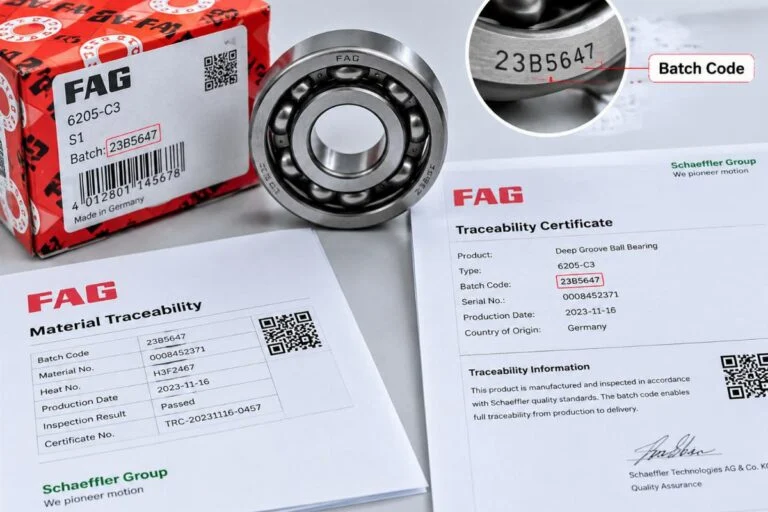
Another major reason for rejection is the lack of traceability documentation. For branded goods like FAG, customs authorities in many countries require proof of authenticity to combat counterfeiting. Without certificates of origin or authorized distribution letters, even a perfectly classified shipment can be held for verification.
A European wind farm operator once experienced a month-long delay because their shipment of FAG bearings lacked consistent batch numbers on the packaging compared to the certificate of origin. Customs suspected gray market goods. The issue was not the HTS code itself, but the inability to prove the supply chain integrity. This highlights that accurate classification is only one part of a flawless customs dossier.
To prevent rejection, ensure that the product description on the invoice matches the technical specifications implied by the HTS code. Include detailed part numbers, assembly states, and material compositions. Consistency across all documents is key to maintaining trust with customs brokers and authorities.

How to Prepare a Flawless Customs Dossier for FAG Bearings?
Combining accurate HTS codes with commercial invoices and origin certs ensures fast clearance.
Preparing a robust customs dossier requires attention to detail at every stage of the export process. Start with the commercial invoice. Each line item should include the full FAG part number, a clear description of the bearing type (e.g., “Deep Groove Ball Bearing”), its assembly state (mounted/unmounted), and the correct HTS code for the destination country. Do not use vague terms like “bearing parts” or “mechanical components.”
Next, secure the necessary traceability documents. Certificates of origin are essential for claiming tariff preferences under free trade agreements. Ensure that the origin stated on the certificate matches the manufacturing location indicated in the product documentation. For FAG bearings, this often means verifying the specific factory of production, as different facilities may have different origin statuses depending on trade policies.
Finally, conduct an internal review before shipment. Cross-check the HTS codes against the latest tariff database of the importing country. Regulations change, and staying updated is critical. A reliable partner will perform this check as part of their service, ensuring that the codes align with local requirements such as the NCM in Brazil or the NCN in other regions.
By integrating accurate classification with complete documentation, you minimize the risk of delays. This approach transforms customs clearance from a potential bottleneck into a routine procedural step. For bulk orders, this efficiency is vital to maintaining project timelines and controlling logistics costs. Working with a FAG bearing HTS codes wholesale supplier for bulk import who understands these complexities ensures that your goods move smoothly from the warehouse to the end-user.

Conclusion
Precision in classification prevents costly delays.
Accurate HTS coding for FAG bearings requires distinguishing between ball and roller types and recognizing the critical difference between mounted and unmounted units. By aligning these technical details with comprehensive traceability documentation, importers can ensure smooth customs clearance. Partnering with a knowledgeable supplier who prioritizes regulatory compliance safeguards your supply chain against unnecessary disruptions and financial losses.