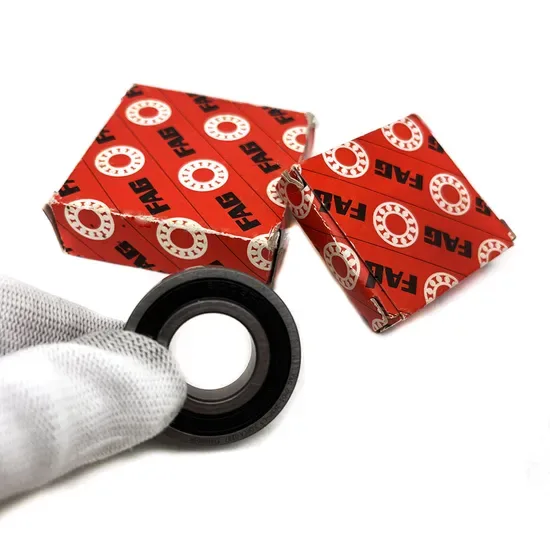
Bulk shipping is not the finish line; it is merely the starting gun for on-site chaos.
A successful storeroom program for FAG bearings integrates procurement, specialized packaging, and digital traceability to prevent mix-ups and corrosion. It requires strict batch isolation at the origin warehouse, upgraded VCI wrapping for harsh environments, and 100% document-to-physical matching with mill test certificates to ensure seamless receiving and zero downtime.
I learned this the hard way in a dusty warehouse in Dongguan, long before I started handling international logistics. Back then, I watched a local factory manager struggle with a container of mixed bearings that had arrived from Europe. The boxes were intact, but the labels were faded, and the rust prevention paper had turned brittle in the humidity. He spent days sorting through hundreds of models, trying to match physical parts with vague packing lists. That experience shifted my perspective entirely. Now, when I look at a bulk order, I do not just see SKUs; I see the potential for operational paralysis if the downstream handling is ignored. This is why effective FAG bearing storage management is less about buying and more about preserving value until the moment of installation.
What are the core components of a FAG bearing storeroom program?
It is an integrated system of procurement, specialized packaging, and digital traceability, not just a purchasing transaction.
Many buyers assume that once the goods leave the factory floor, their responsibility ends. In reality, the storeroom program begins at the point of consolidation. For MRO managers and mining operators, the goal is to maintain the integrity of high-precision components across complex supply chains. The core components must address three critical failure points: physical damage during transit, chemical degradation through corrosion, and administrative confusion through poor documentation.
When dealing with bulk bearing warehouse consolidation, the first component is standardized intake. This means every unit must be verified against a master list before it enters the storage ecosystem. Without this, you are building inventory on sand. The second component is environmental control. Bearings are sensitive to humidity and temperature fluctuations. Even in sealed packaging, prolonged exposure to tropical climates can compromise internal lubricants and raceway surfaces.
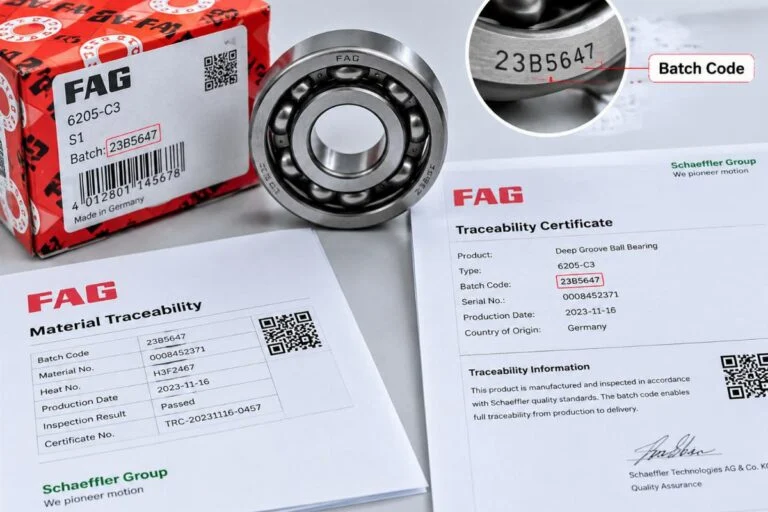
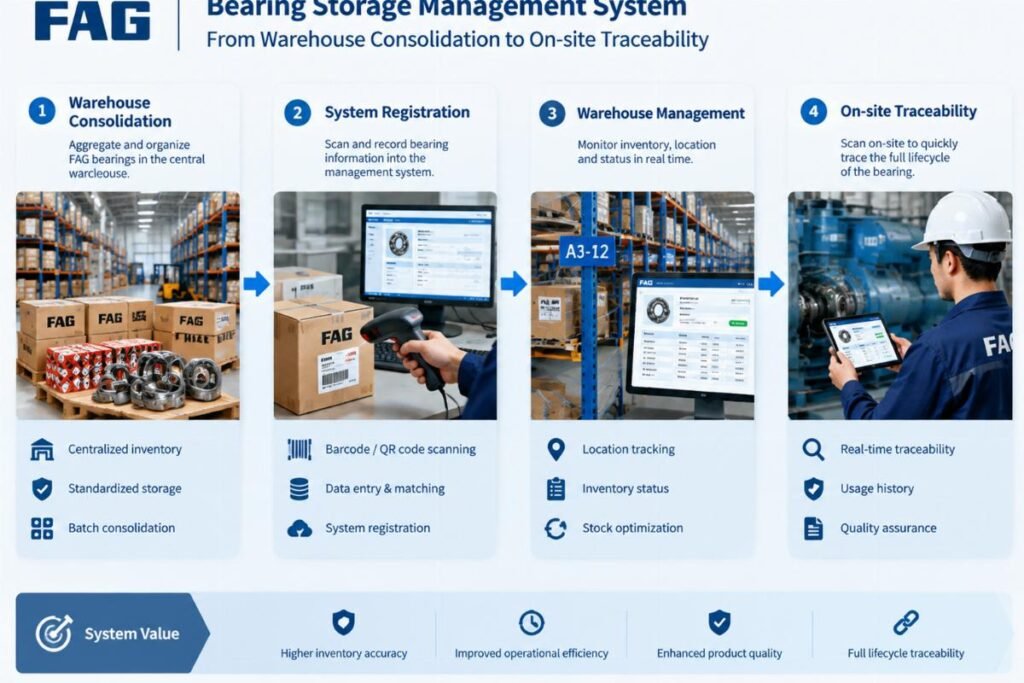
The third component is data continuity. A physical bearing without its corresponding certificate is just a piece of metal. In regulated industries like mining or wind power, the ability to trace a specific batch back to its production run is mandatory for safety audits. Our approach to FAG bearing traceability and packaging ensures that the digital record travels with the physical item, creating a closed loop from the manufacturer’s facility to your site’s crib.

How to prevent mix-ups during bulk mixed-batch consolidation?
Standardized labeling and strict batch isolation at the origin warehouse are non-negotiable.
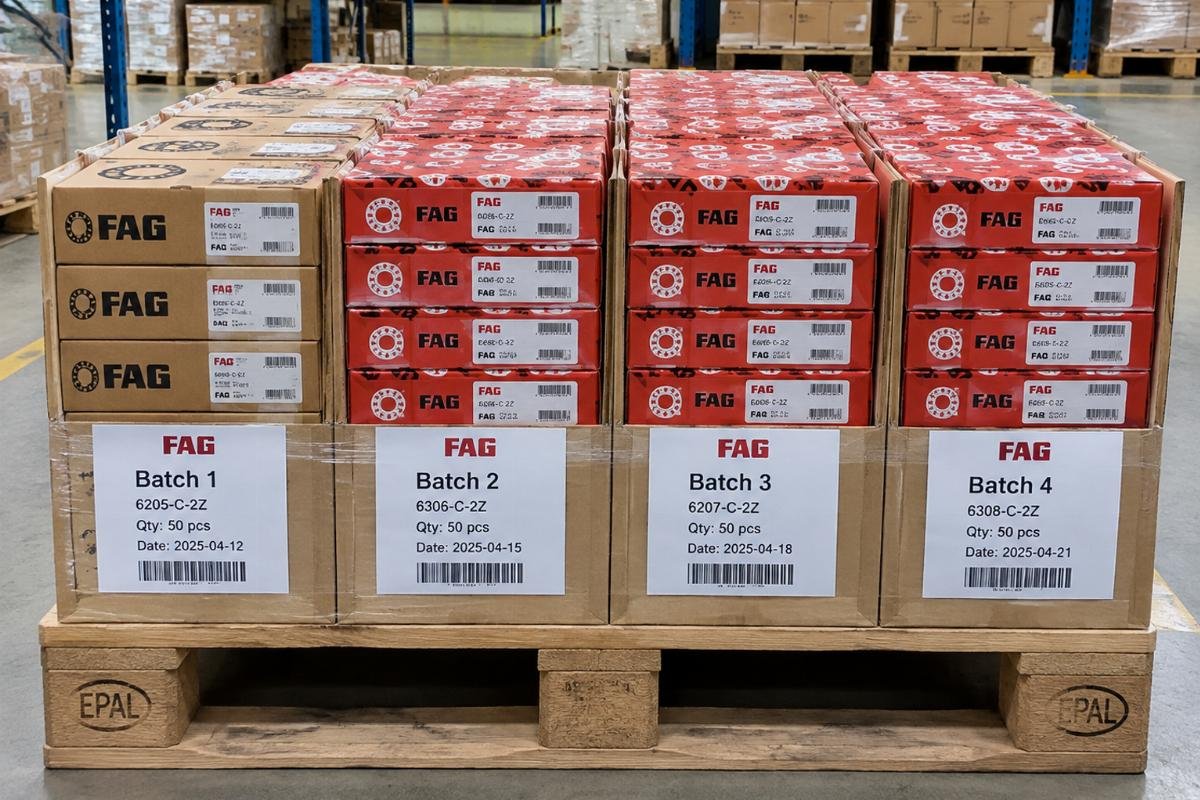
One of the most common pitfalls in global sourcing is the assumption that all bearings of the same model are identical. They are not. Different production batches can have slight variations in internal clearance or cage material. Mixing these batches in a single bin creates a nightmare for maintenance teams who rely on consistent performance.
Consider a recent project involving a Middle East mining site. The client ordered hundreds of different FAG models, ranging from small deep-groove ball bearings to massive spherical roller bearings. If these had been shipped in loose bulk without segregation, the receiving team would have faced weeks of manual sorting. Instead, we implemented a rigorous isolation protocol. Each SKU was packed in its own distinct inner box, clearly labeled with the batch number and production date. These inner boxes were then grouped by equipment type on pallets, rather than by size alone.
This method prevents the “needle in a haystack” scenario. When a maintenance technician needs a specific replacement for a crusher, they can locate the exact pallet without disturbing other inventory. The key is to treat the warehouse as an extension of the assembly line. If the label does not match the physical item exactly, the item is quarantined. This discipline reduces the risk of installing the wrong bearing, which can lead to catastrophic equipment failure.
| Risk Factor | Standard Practice | Optimized Storeroom Program |
|---|---|---|
| Batch Handling | Mixed bins by model number | Strict isolation by production batch |
| Labeling | Generic brand labels only | Detailed batch code and date inclusion |
| Palletization | Random stacking by weight | Grouped by application or equipment type |
| Verification | Visual check at receipt | Barcode scan against master packing list |
What packaging is required for long-term storage in harsh environments?
Upgraded VCI wrapping and moisture-proof palletizing are mandatory for MRO storerooms.
Many assume standard factory packaging is sufficient for long-term storage. This is a dangerous misconception, especially for sites in coastal regions or humid tropics. Standard cardboard and thin plastic wraps offer minimal protection against salt spray and high humidity. Over time, moisture penetrates the packaging, leading to surface rust that can pit the raceways and destroy the bearing before it is even installed.
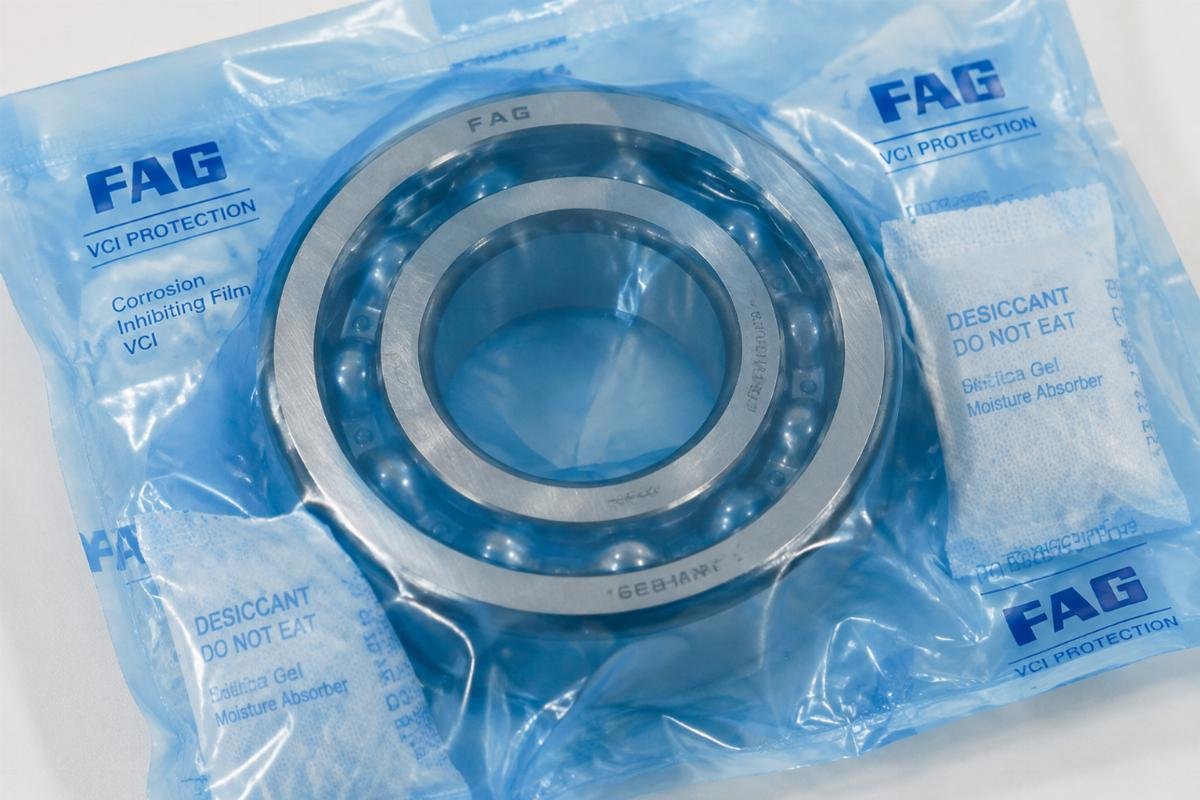
To combat this, we utilize Volatile Corrosion Inhibitor (VCI) technology. VCI emitters release microscopic protective molecules that settle on the metal surface, forming a molecular layer that blocks moisture and oxygen. This is not just a extra wrap; it is an active chemical shield. For bulk orders destined for harsh environments, we upgrade the standard packaging to include heavy-duty VCI bags and desiccant packs within each individual box.
Furthermore, the outer palletization must be robust. We use shrink-wrapped pallets with corner boards to prevent compression damage during stacking. The wood used for pallets is treated to meet international phytosanitary standards, ensuring no pests or excess moisture are introduced into the storeroom. This level of care ensures that when a bearing is pulled from stock after months or even years, it remains in pristine condition. The cost of this upgraded packaging is negligible compared to the cost of replacing a failed bearing in a remote mining operation.
How to ensure full traceability for customs and on-site receiving?
100% document-to-physical matching with mill test certificates speeds up inspection and ensures compliance.
Traceability is often viewed as a bureaucratic hurdle, but it is actually a critical quality assurance tool. For customs clearance, having the correct paperwork is essential to avoid delays. But more importantly, for on-site receiving, it allows for rapid verification. When a container arrives, the receiving team should not have to guess what is inside. Every box should correspond to a line item on the packing list, which in turn matches the mill test certificates provided.
We structure our documentation to align perfectly with the physical goods. Each pallet receives a unique identifier that links to a digital folder containing all relevant certificates for that batch. This includes material composition reports, hardness tests, and dimensional inspections. This system allows MRO managers to audit their inventory quickly. If a question arises about a specific batch’s origin, the answer is a click away, not a dig through a filing cabinet.
This level of transparency builds trust. It proves that the bearings are genuine and have been handled according to strict quality protocols. For industries where downtime costs thousands of dollars per hour, the ability to verify inventory instantly is invaluable. It transforms the storeroom from a black box into a transparent, manageable asset.

Conclusion
Effective storage is the silent guardian of equipment reliability.
A robust FAG bearings storeroom programs strategy goes beyond simple acquisition. It demands disciplined batch isolation, advanced corrosion protection, and seamless data traceability. By treating inventory management as a technical discipline rather than an administrative task, operators can eliminate costly errors and ensure that every bearing performs as intended when it matters most.