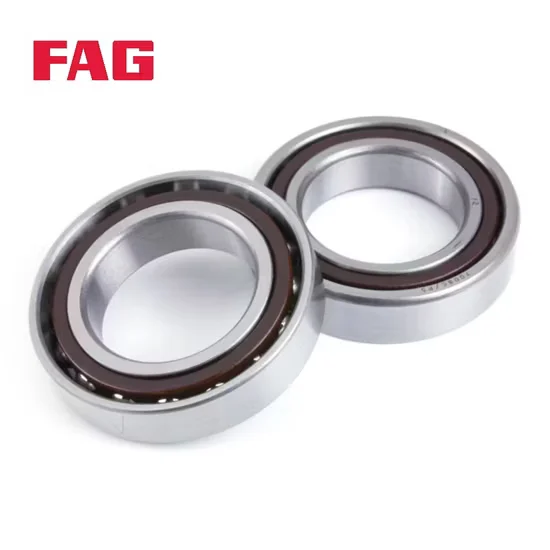
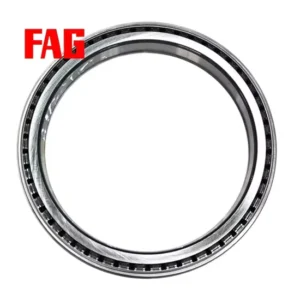
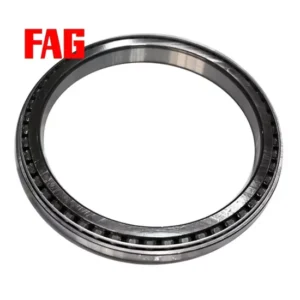

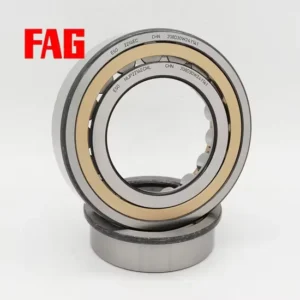
Product details
Description and application notes
Authenticity Verification — Every FAG B7040-E-T-P4s-UL angular contact ball bearing we dispatch includes an official app QR code for immediate batch traceability and counterfeit prevention.
Technical Specifications
| Parameter | Value |
|---|---|
| Designation | FAG B7040-E-T-P4s-UL |
| Bearing Type | Angular Contact Ball Bearing |
| Bore Diameter (d) | 200 mm |
| Outside Diameter (D) | 310 mm |
| Width (B) | 51 mm |
| Contact Angle | 25° |
| Precision Class | P4s |
| Material | Steel |
| Certification | ISO |
Note: The T and UL suffixes require manufacturer catalog confirmation for exact cage material and preload/pairing specifications.
Application Suitability
| Industry | Typical Applications |
|---|---|
| Machine Tool Manufacturing | High-speed lathe spindles and precision CNC turning centers |
| Industrial Pumps | High-speed pump shafts requiring strict radial and axial rigidity |
| Precision Equipment | Optical measuring instruments and high-accuracy rotary tables |
Preventing Spindle Catastrophes Through Precision Sourcing
Vibration and thermal runaway destroy lathe spindles when tolerance stacks are ignored.
Sourcing authentic precision components is critical to avoiding costly downtime and counterfeit risks in high-speed machining operations. I have seen production lines halted because a standard tolerance bearing was forced into a precision spindle housing, leading to immediate vibration and catastrophic shaft failure. When specifying a FAG B7040-E-T-P4s-UL angular contact ball bearing, verifying the exact precision class and contact angle is non-negotiable to maintain the microscopic clearances required for flawless surface finishes.
Matching the 25° Contact Angle to Lathe Cutting Forces
The specific geometry of this FAG B7040-E-T-P4s-UL angular contact ball bearing dictates its load-carrying behavior under heavy cutting operations. A 25° contact angle provides an optimized balance between radial support and axial thrust capacity, which is exactly what a lathe spindle experiences during facing and turning cycles. Our engineering team cross-checks these load vectors against your specific machining parameters to ensure the spindle maintains rigidity without premature deflection.
Navigating Thermal Expansion and Lubrication in High-Speed Spindles
Spindle environments generate intense localized heat, demanding careful consideration of thermal expansion and lubrication regimes. At elevated rotational speeds, the friction between the rolling elements and raceways necessitates precise oil-air or grease lubrication to prevent thermal seizure. The internal clearance and preload must accommodate the temperature gradient between the inner and outer rings, otherwise the bearing will bind and fail. Selecting the correct pairing ensures the bearing survives these extreme thermal cycles while maintaining rotational accuracy.
Decoding the P4s Precision and E Suffix Architecture
The P4s precision class ensures tighter dimensional and running accuracy than standard P4, which is vital for minimizing spindle runout and achieving mirror-like surface finishes. The E suffix explicitly designates the 25° contact angle, providing the necessary axial rigidity for heavy-duty turning applications. Spindle applications demand this exacting level of geometric control to prevent chatter marks on the workpiece. The steel construction delivers reliable durability under the intense rotational stresses of continuous CNC operations, maintaining structural integrity when subjected to prolonged cutting forces.
The Financial Impact of Spindle Downtime and Misapplication
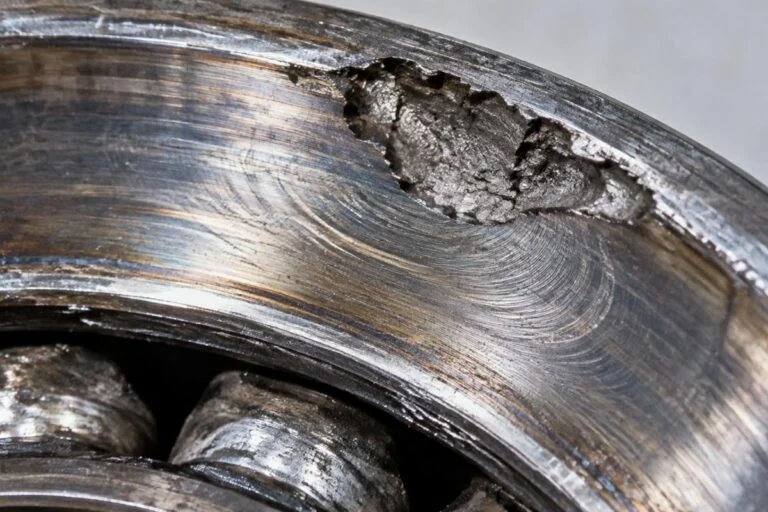
Installing an incorrectly specified component into a precision spindle results in unplanned downtime that far exceeds the cost of the bearing itself. Premature failure often manifests as severe chatter, ruined workpieces, and catastrophic damage to the spindle housing. According to failure mode classifications, improper preload or mismatched contact angles rapidly accelerate fatigue and surface distress on the raceways. Warranty voidance is almost guaranteed when traceability and precision certificates are missing during post-failure audits.
Securing Traceability and Technical Alignment for Spindle Bearings
We prioritize genuine original bearings with complete traceability documentation, ensuring every unit can be verified back to the manufacturer's production facilities. Our team provides cross-brand equivalent model consultation, helping you align this selection with alternatives like the B71905-C-T-P4s when dimensional constraints require a different series. We maintain massive spot inventory covering thousands of standard part numbers, allowing us to fulfill urgent maintenance requirements without typical multi-week lead times. Furthermore, our technical selection support ensures the exact preload and pairing suffixes are validated before shipment, preventing the tragic mismatches I used to investigate in the field.
Documentation & Authenticity
- Certificate of Conformity confirming P4s precision class and dimensional tolerances.
- Official app QR code on the packaging for immediate batch traceability and counterfeit verification.
- Running accuracy inspection report validating the 25° contact angle and axial runout limits.
- Material test certificates verifying the steel composition for high-speed spindle durability.
- Origin documentation ensuring compliance with international trade and customs requirements.
Storage, Handling & Mounting
- Keep the matched set sealed in its original packaging until mounting to protect the P4s precision raceways from microscopic dust contamination.
- Use clean, lint-free gloves when handling the bearing to prevent moisture and acidic residues from compromising the steel surfaces.
- Verify the spindle housing bore and shaft journal dimensions with calibrated micrometers before installing this high-precision component.
- Follow the manufacturer's specified induction heating parameters for the inner ring to avoid thermal shock and retain dimensional stability.
- Ensure the mounting tools apply force strictly to the inner ring during press-fitting to prevent brinelling the 25° contact angle raceways.
Engineering Validation for Your Spindle Application
To guarantee optimal performance, please share your specific radial and axial load profiles, operational speed ranges, and thermal conditions. Providing the original equipment manufacturer's part number or spindle assembly drawing allows our technical team to perform a comprehensive cross-reference alignment and L10 life calculation. This data enables us to confirm the precise pairing, preload, and lubrication requirements for your exact machining environment, eliminating guesswork and safeguarding your spindle investment.
Frequently Asked Questions
Q: How does the P4s precision class differ from standard P4 for lathe spindles?
A: The P4s class enforces stricter limits on dimensional tolerances and running accuracy compared to standard P4. This tighter control minimizes radial and axial runout, which is critical for achieving superior surface finishes and preventing chatter during high-speed turning operations on precision lathes.
Q: What does the E suffix indicate on this angular contact ball bearing?
A: The E suffix designates a 25° contact angle. This specific geometry optimizes the bearing's capacity to handle combined radial and axial loads, providing the necessary rigidity and thrust support required for heavy-duty facing and turning cycles in lathe spindles.
Q: Can this bearing be cross-referenced with other precision series?
A: Yes, we frequently cross-reference this model with alternatives like the B71905-C-T-P4s when space constraints or specific load profiles dictate a different dimensional series. Our engineering team validates the clearance, cage design, and precision equivalents to ensure seamless integration into your existing spindle housing.
Q: How should we verify the authenticity of the received spindle bearings?
A: Every genuine unit includes an official app QR code on the packaging. Scanning this code provides immediate access to batch traceability, manufacturing dates, and origin data, effectively eliminating the risk of installing counterfeit components that could cause catastrophic spindle failure.
Q: What lubrication is recommended for high-speed lathe spindle applications?
A: High-speed spindles typically require precise oil-air or high-speed spindle grease lubrication. The exact choice depends on your specific rpm and thermal management setup. We recommend consulting the machine tool builder's specifications to determine the optimal lubricant and replenishment intervals for this precision class.