More heat does not mean easier installation.
Proper FAG bearing heating requires strict temperature control via induction methods to prevent localized annealing, with sealed units capped at lower thresholds than open bearings to preserve lubricant integrity and structural hardness.
Walking through a maintenance yard in Chicago, I once watched a technician use an oxy torch on a large spherical roller bearing. The goal was simple: expand the inner ring enough to slide it onto a shaft without force. The result was less ideal. The bearing seated easily, but the localized heat from the flame created a soft spot in the steel. Months later, the raceway spalled under normal load. This is not an isolated incident. Across many MRO operations, the misconception that hotter equals faster persists, leading to premature failures that are often misdiagnosed as manufacturing defects rather than installation errors.
The core issue lies in the metallurgy. Bearing steel is hardened to withstand immense contact stresses. When exposed to uncontrolled high temperatures, particularly from open flames, the steel can exceed its tempering temperature. This process, known as annealing, reduces the hardness of the material. A softened raceway cannot support the designed load, leading to rapid deformation and fatigue. For distributors and end-users alike, understanding the correct thermal expansion principles is critical to avoiding these costly mistakes.
Transitioning from destructive practices to precise methods requires a shift in both equipment and mindset. The following sections detail why traditional methods fail, how to select the right tools, and the specific limits that must be respected during installation.
Why Do FAG Bearings Fail During Heating?
Open flames cause localized annealing and destroy hardness.
The primary reason for heating a bearing is to exploit thermal expansion. As the metal heats, the inner diameter expands, allowing for a slip fit onto a shaft that would otherwise require excessive mechanical force. However, the method of heat application determines whether this expansion is uniform or destructive.
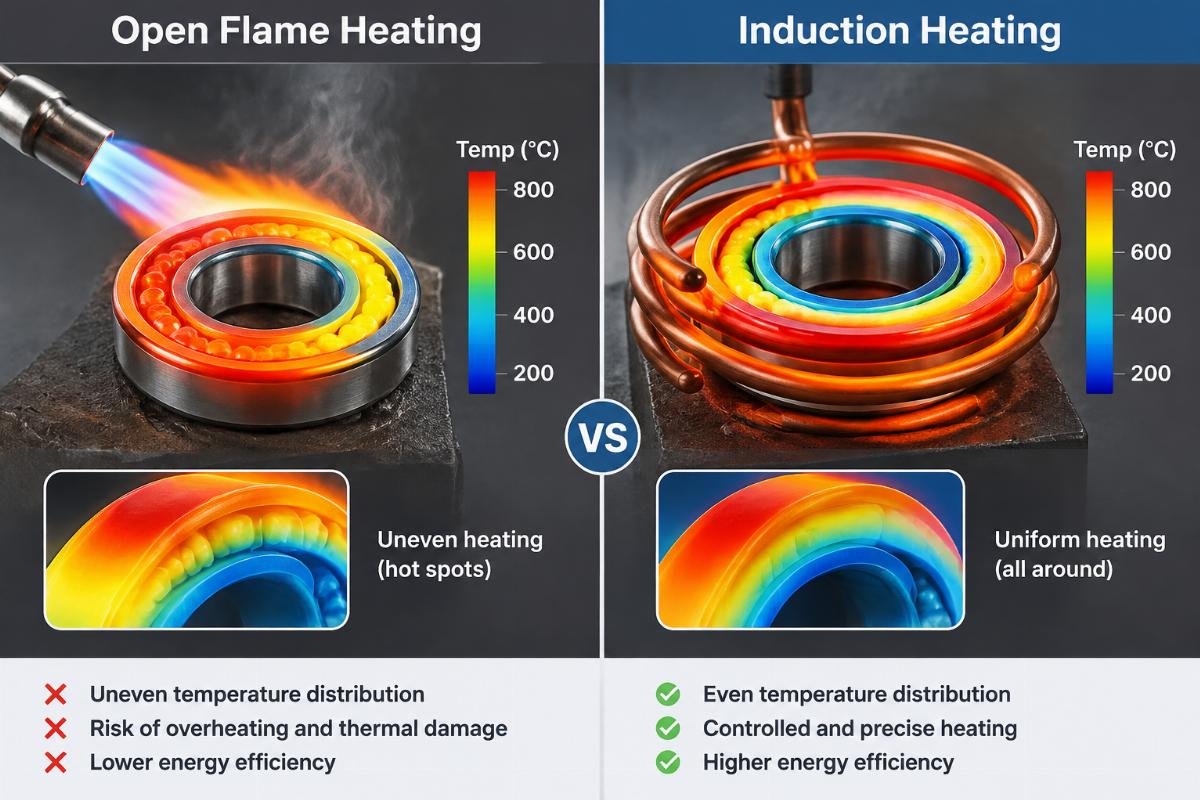
Open flame heating, such as using a propane or oxy-acetylene torch, is notoriously uneven. The flame creates a steep temperature gradient across the bearing surface. While one section may reach the desired expansion temperature, adjacent areas remain cool, and the point of direct contact can skyrocket well beyond safe limits. This uneven heating induces thermal stress within the component. More critically, if the temperature exceeds the tempering threshold of the bearing steel, the microstructure changes. The hardened martensite transforms into softer structures, permanently reducing the load-carrying capacity.
In contrast, induction heating generates heat within the material itself through electromagnetic fields. This results in a much more uniform temperature distribution across the ring. For MRO shops handling high-value assets, the risk of annealing with open flames is simply too high. The cost of a replacement bearing and the downtime associated with a secondary failure far outweigh the initial savings of using a cheap torch.
Consider a case involving a conveyor system in a heavy industrial plant. The maintenance team used a torch to heat a series of pillow block bearings. Initially, the installation seemed successful. However, within a few months, multiple bearings exhibited early signs of flaking. Analysis revealed that the raceways had lost their hardness due to localized overheating. Switching to induction heaters eliminated this pattern of failure, ensuring that the thermal expansion was achieved without compromising the material properties.
How to Choose the Right Induction Heater?
Match kVA and yoke size to bearing mass for uniform flux.
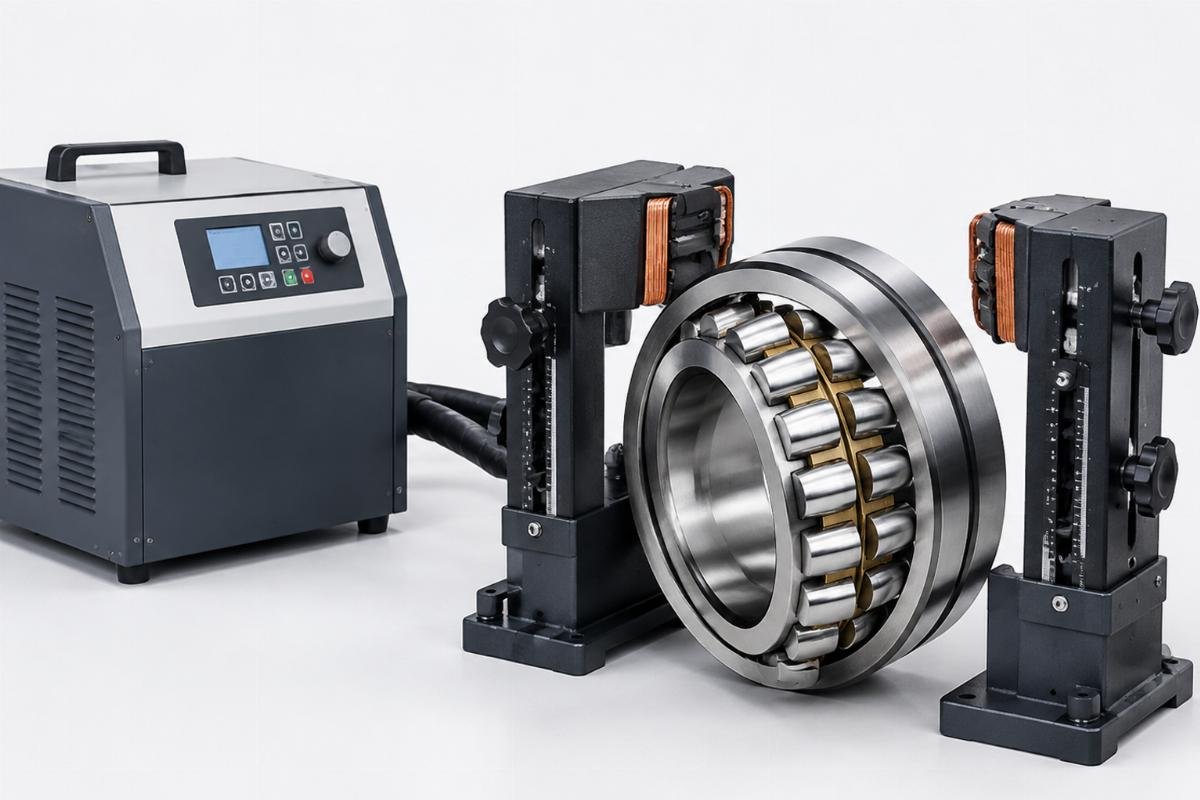
Selecting the appropriate induction heater is not just about picking the most powerful unit available. It requires matching the device’s capabilities to the specific bearing dimensions and mass. An undersized heater will struggle to reach the target temperature efficiently, while an oversized one may heat too rapidly, making temperature control difficult.
The key parameters to consider are the power output (kVA) and the yoke configuration. The yoke directs the magnetic flux through the bearing. For larger bearings, such as those used in mining crushers or wind turbine gearboxes, a heater with higher power and a larger yoke cross-section is necessary to penetrate the mass effectively. For smaller, precision bearings found in machine tools, a lower power unit with a finer yoke allows for greater control and prevents accidental overheating of adjacent components.
| Feature | Small/Medium Bearings | Large/Heavy Bearings |
|---|---|---|
| Power Requirement | Lower kVA sufficient | Higher kVA required for mass |
| Yoke Size | Smaller cross-section | Larger cross-section for flux penetration |
| Heating Speed | Fast, requires careful monitoring | Slower, more gradual expansion |
| Control Precision | High sensitivity needed | Standard control adequate |
A US buyer once reported difficulties installing large cylindrical roller bearings on a paper mill dryer section. They were using a small, portable induction heater intended for automotive hubs. The heater ran continuously for an extended period but failed to expand the inner ring sufficiently. The technician eventually resorted to mechanical force, damaging the shaft. After switching to a higher-capacity induction unit with a yoke sized for the bearing’s outer diameter, the heating time dropped noticeably, and the bearings slid into place with zero force.
It is also essential to ensure the heater has reliable temperature feedback. Modern units come with integrated sensors or allow for external pyrometers. This feedback loop is crucial for stopping the heating process exactly when the target temperature is reached, preventing any risk of overshoot.
What Are the Safe Temperature Limits?
Strictly cap at 120°C for sealed and 80°C for pre-lubricated units.
Temperature limits are not arbitrary; they are dictated by the bearing’s construction and lubrication. Exceeding these limits can degrade seals, alter lubricant viscosity, or damage cages, even if the steel itself remains hard.
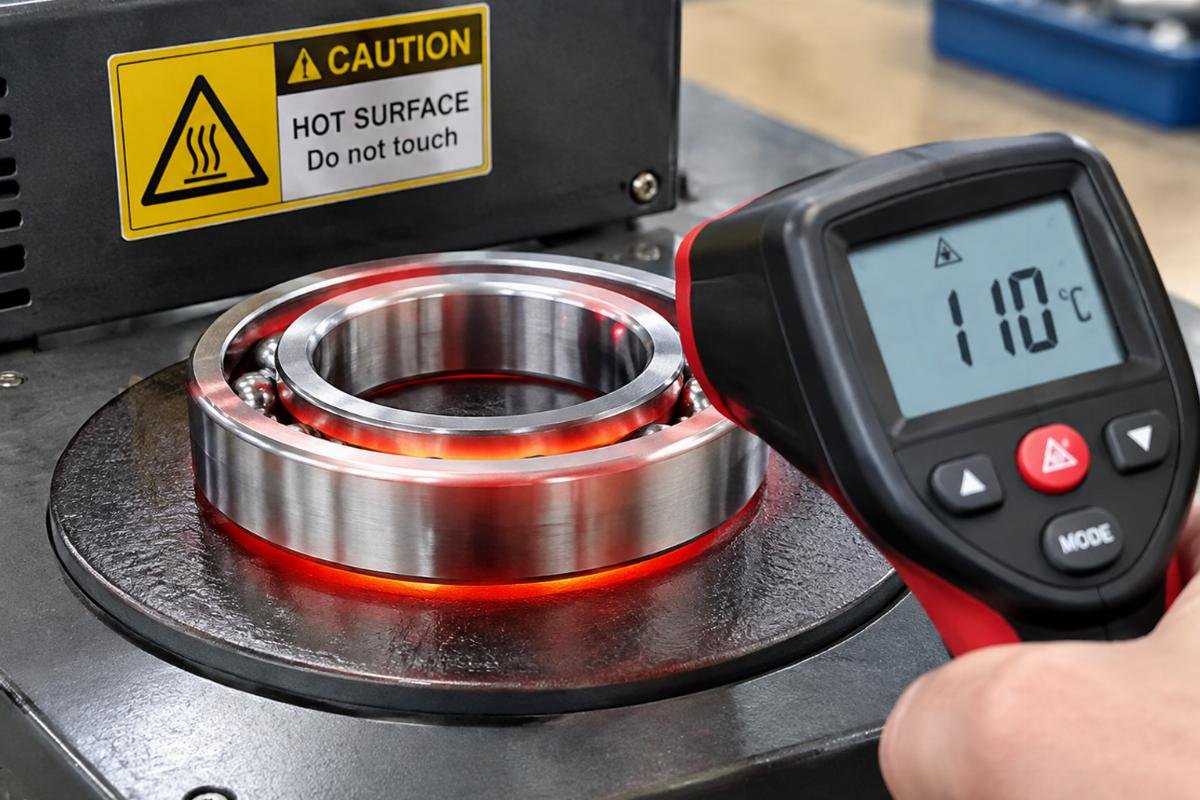
For standard open bearings made of bearing steel, the maximum safe heating temperature is generally around 120°C. This limit ensures that the steel does not approach its tempering temperature, which typically starts higher but varies by grade. However, for bearings that are pre-lubricated or have seals, the limits are significantly lower. Seals, often made from rubber or synthetic materials like NBR or FKM, can deform or lose their sealing properties if exposed to temperatures above 80°C to 100°C. Similarly, grease can break down, separate, or leak out if heated excessively, leaving the bearing unprotected upon startup.
| Bearing Type | Max Heating Temperature | Primary Risk if Exceeded |
|---|---|---|
| Open Bearings | Up to 120°C | Annealing of steel (if much higher) |
| Sealed Bearings | Max 80°C – 100°C | Seal deformation and leakage |
| Pre-lubricated | Max 80°C | Grease breakdown and separation |
| Ceramic/Hybrid | Consult Manufacturer | Material-specific thermal shock |
In an automotive hub assembly scenario, a technician heated a sealed unit to 150°C to ensure a loose fit. The bearing installed easily, but the seal melted slightly, allowing contaminants to enter immediately. The hub failed shortly after due to contamination-induced wear. Adhering to the lower temperature limit for sealed units would have preserved the integrity of the seal and the lubricant inside.
When dealing with special materials or hybrid bearings, such as those with ceramic rolling elements, the thermal expansion coefficients differ between the steel rings and the ceramic balls. Heating these components requires even greater caution and often specific guidance from the manufacturer to avoid inducing stress due to differential expansion.
How to Execute a Step-by-Step Heating Process?
Clean, position, monitor with sensors, and install immediately.
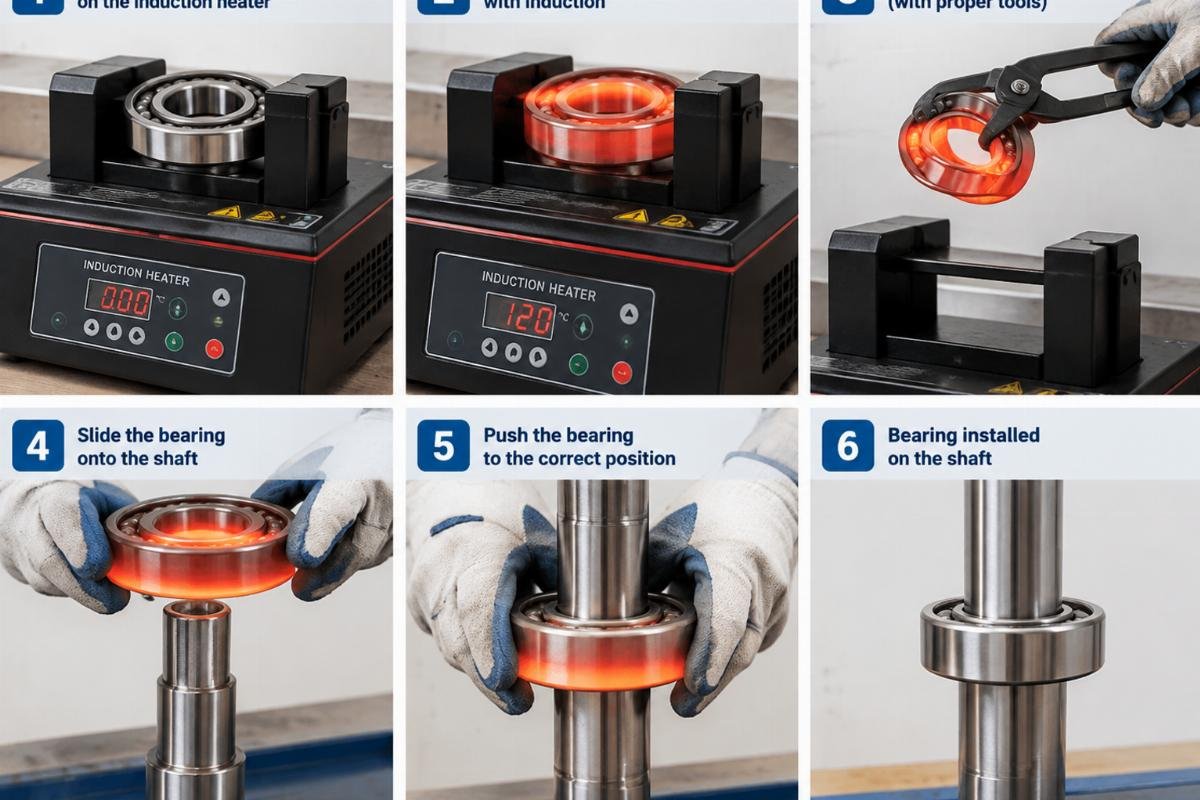
A successful installation is a sequence of precise actions. Deviating from this process can introduce contaminants or allow the bearing to cool before it is seated, leading to a stuck fit.
- Preparation and Cleaning: Before heating, ensure the shaft and housing are clean and free of burrs. Any debris on the shaft can score the bearing inner ring during installation. Verify that the shaft diameter is within tolerance.
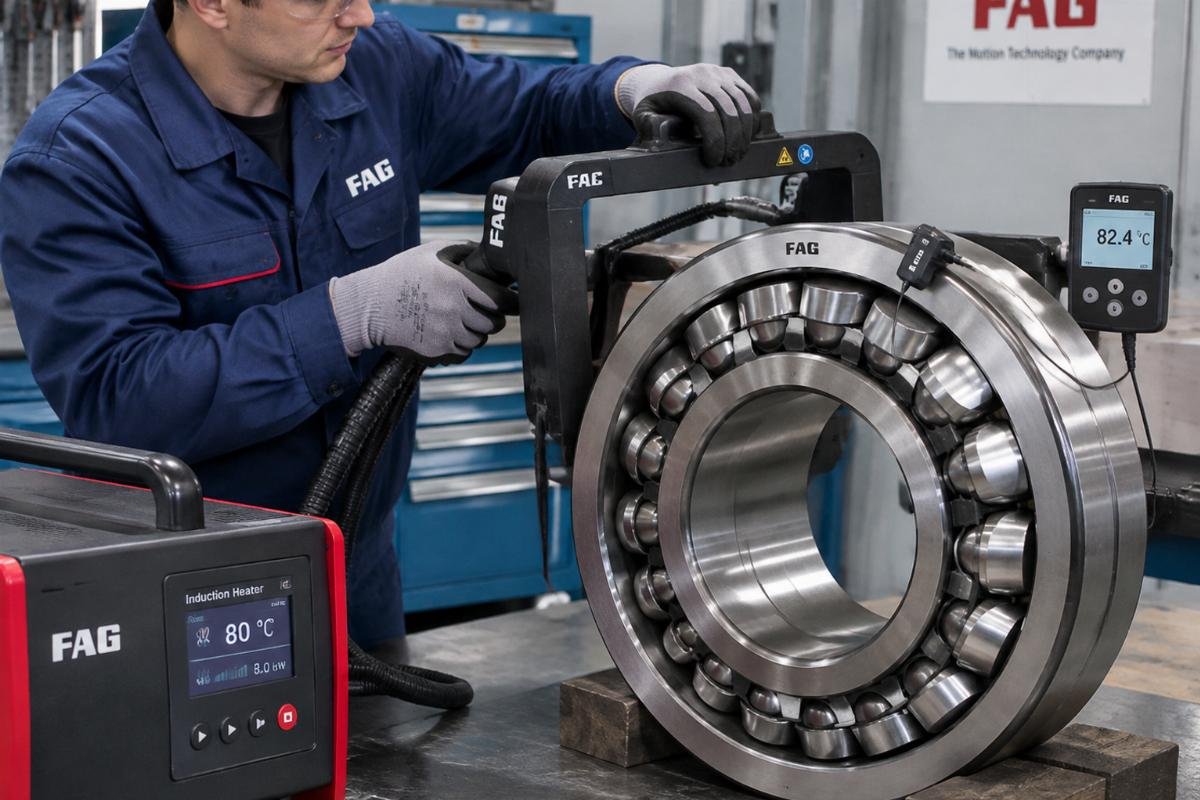
- Positioning the Heater: Place the induction heater’s yoke through the bearing’s inner ring. Ensure the bearing is centered on the yoke to promote uniform heating. If the bearing has a cage, ensure the yoke does not interfere with it.
- Monitoring Temperature: Attach a temperature sensor or use a handheld infrared pyrometer to monitor the bearing’s temperature. Do not rely on time alone, as ambient conditions and bearing mass vary. Start the heater and watch the temperature rise steadily.
- Reaching Target Temperature: Stop heating once the target temperature is reached. For open bearings, this is typically below 120°C. For sealed units, keep it below 80°C. Allow a few seconds for the temperature to equalize across the ring.
- Immediate Installation: Quickly remove the bearing from the heater and slide it onto the shaft. Use a protective sleeve or glove to handle the hot bearing. Push it firmly against the shaft shoulder. The bearing should slide on with minimal resistance. If it sticks, do not force it. Reheat if necessary, but avoid repeated heating cycles which can affect the material.
- Cooling and Inspection: Hold the bearing in place until it cools and shrinks onto the shaft. Once cool, verify that it is seated correctly against the shoulder. Check for any signs of damage or misalignment.
A common error observed in field operations is delaying the installation after heating. As the bearing cools, it contracts. If the technician waits too long, the inner diameter shrinks back to its original size, making installation impossible without force. In one instance at a steel plant, a team heated a large bearing but spent several minutes preparing the lifting gear. By the time they attempted installation, the bearing had cooled significantly, requiring them to reheat it. This extra cycle increased the risk of uneven heating and wasted valuable maintenance time.
Conclusion
Precision heating prevents premature failure.
Proper installation of FAG bearings relies on controlled thermal expansion rather than brute force or excessive heat. By using induction heating and adhering to strict temperature limits, MRO shops and industrial operators can ensure that bearings retain their designed hardness and lubrication integrity. Avoiding open flames and monitoring temperature closely eliminates the risk of annealing and seal damage. This disciplined approach extends service life and reduces unplanned downtime, protecting both equipment and operational budgets.