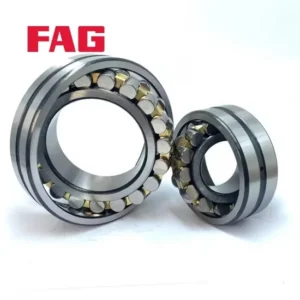
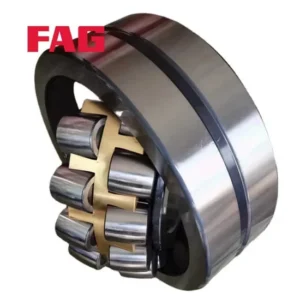
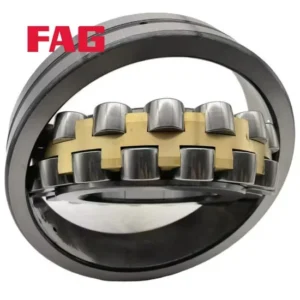
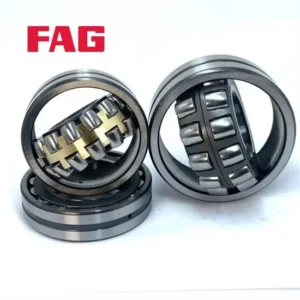
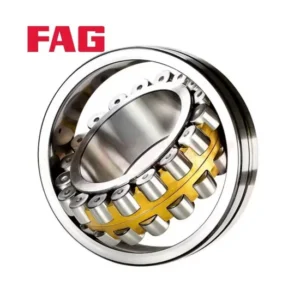
Product details
Description and application notes
Unified Brand Sourcing — Consolidate FAG and other premium lines into a single shipment without juggling multiple vendors for your maintenance inventory.
Technical Specifications
| Parameter | Value |
|---|---|
| Designation | FAG 21308-E1 |
| Bearing Type | Spherical Roller Bearing |
| Bore Diameter (d) | 40 mm |
| Outside Diameter (D) | 90 mm |
| Width (B) | 23 mm |
| Structure | Double Row, Self-Aligning |
| Cage Material | Steel / Brass / Nylon (available options) |
| Main Material | Chrome Steel Gcr15 |
| Precision Class | P0 / P6 / P5 (available options) |
Note: The '1' in the designation is an unverified suffix requiring manufacturer catalog confirmation.
Application Suitability
| Industry | Typical Applications |
|---|---|
| Mining & Construction | Vibrating screens, crushers, and heavy-duty conveyors |
| Metallurgy & Steel Mills | Continuous casting machines and rolling mill stands |
| Pulp & Paper | Paper machine dryer cylinders and press rolls |
Why Misalignment Destroys Heavy Machinery Before the Steel Fails
Self-aligning geometry absorbs shaft deflection that would otherwise shatter rigid bearing types.
In heavy industrial environments, shaft bending and housing misalignment are inevitable consequences of continuous operation under extreme stress. When standard rigid bearings face these unavoidable conditions, edge loading causes rapid surface fatigue and spalling. Sourcing a reliable FAG 21308-E1 spherical roller bearing ensures the symmetrical barrel rollers freely adjust within the spherical outer ring raceway, effectively compensating for angular errors and shaft deflections.. Ignoring this critical self-aligning capability during the procurement phase often leads to catastrophic unplanned downtime, a harsh lesson I learned early in my career when supplying cement plants in Riyadh.
Matching the Double-Row Design to Demanding Environments
The dual-row configuration distributes heavy radial loads across a broader contact area, making this FAG 21308-E1 spherical roller bearing exceptionally well-suited for vibrating screens, heavy-duty crushers, and continuous casting machines. Our dedicated engineering team carefully cross-references equivalent models across premium global brands to ensure precise dimensional interchangeability when original equipment manufacturer lead times are prohibitively long. This proactive technical selection support prevents costly machine modifications and ensures smooth integration during urgent maintenance replacements, keeping your critical production lines running without interruption.
Navigating Load, Speed, and Thermal Expansion Challenges
Heavy machinery generates significant friction heat during continuous operation, which directly impacts the internal clearance and overall performance. Early in my procurement career, I shipped standard clearance units to a Riyadh cement facility without thoroughly verifying the high-temperature operating environment of the kiln section. The resulting thermal expansion caused the internal clearance to vanish completely, leading to thermal seizure and extensive unplanned downtime. Now, I always scrutinize the operating temperature to specify larger radial clearance variants when necessary. Establishing proper lubrication intervals and selecting the correct cage material further mitigate the risks of high-speed thermal degradation and lubricant breakdown..
Decoding the E1 Suffix and Internal Geometry
The 'E' suffix indicates an optimized internal construction featuring reinforced roller and raceway contact profiles designed for maximum efficiency. This enhanced design significantly increases the radial load-carrying capacity and improves the overall kinematic performance of the rolling elements under heavy stress. By maximizing the contact area between the rollers and the raceway, the bearing effortlessly withstands the severe shock loads typical in mining, quarrying, and metallurgical applications. The absence of a central rib allows for the installation of longer, larger rollers, directly translating to extended service life under extreme radial loading conditions. Selecting the correct cage type—whether pressed steel for high-speed operations or machined brass for heavy-vibration environments—perfectly complements this reinforced internal geometry.
The Hidden Costs of Incorrect Clearance and Cage Selection
Specifying the wrong internal clearance or cage material for high-vibration and high-temperature environments inevitably triggers premature mechanical failure. According to established ISO 15243 frameworks, inadequate internal clearance leads to excessive preload, generating intense friction heat that rapidly degrades the lubricant and softens the raceway surface. Conversely, a cage unable to withstand severe vibrational shocks will eventually fracture, causing catastrophic roller skewing and complete machine seizure. These preventable failures result in severe collateral damage to shafts, housings, and adjacent components, voiding equipment warranties and inflating repair costs far beyond the initial component price..
Securing Authentic Components for Critical Assets
The global industrial market is unfortunately flooded with counterfeit spherical roller bearings that fail catastrophically under nominal loads. We guarantee genuine original products with complete, verifiable traceability documentation for every FAG 21308-E1 spherical roller bearing shipped from our facilities. Our massive spot inventory covers thousands of standard and special part numbers, enabling flexible mixed-brand consolidation for bulk project orders and urgent maintenance requirements. When sourcing reinforced designs, verifying the exact suffix and internal geometry prevents receiving substandard alternatives that compromise safety. We provide comprehensive after-sales technical support, including detailed failure analysis, to ensure long-term operational reliability for your heavy equipment assets.
Documentation & Authenticity
- Certificate of Conformity verifying the exact E1 internal geometry designation.
- Original factory batch traceability documents linked to the specific production run.
- Official manufacturer app QR code verification for anti-counterfeiting validation.
- Material inspection reports confirming Chrome Steel Gcr15 metallurgical composition.
- Dimensional and running accuracy inspection reports validating P-class tolerances.
Storage, Handling & Mounting
- Store the double-row units in original packaging to protect the spherical outer raceway from humidity.
- Maintain stable warehouse temperatures to prevent condensation inside the reinforced roller assembly.
- Use clean gloves when handling to avoid contaminating the optimized raceway contact profiles.
- Apply induction heating for cylindrical bore mounting to preserve the precise internal clearance.
- Follow strict lubrication protocols post-mounting to protect the steel or brass cage options.
Engineering Review and Selection Support
To ensure optimal performance and longevity, please share your specific radial and axial load profiles, operating speeds, and ambient temperature ranges. Providing the original equipment manufacturer part numbers allows our technical team to perform precise cross-reference verification and L10 life recalculations. This data-driven approach guarantees the selected configuration perfectly matches your application's unique mechanical and thermal demands. Furthermore, detailing your maintenance schedules and lubrication practices helps us recommend the most suitable cage and clearance options, ultimately reducing your total cost of ownership and maximizing equipment uptime.
Frequently Asked Questions
Q: How does the E1 suffix affect the load capacity of this bearing?
A: The E1 designation signifies an optimized internal geometry with reinforced roller and raceway contact profiles. This design maximizes the contact area, significantly increasing the radial load-carrying capacity compared to standard constructions. It is specifically engineered to withstand the severe shock loads and heavy radial stresses encountered in mining, crushing, and metallurgical applications without premature fatigue.
Q: What factors determine the correct cage material for my application?
A: Cage selection depends on your specific operating conditions, including speed, load, and vibration levels. Pressed steel cages are generally suitable for high-speed applications with moderate loads, while machined brass cages offer superior durability and shock resistance for heavy-vibration environments like vibrating screens. Our engineering team can analyze your operational data to recommend the most reliable cage option.
Q: How can I verify the authenticity of the supplied bearings?
A: Every unit we supply includes comprehensive traceability documentation and a Certificate of Conformity. You can verify authenticity using the official manufacturer application via the QR code provided on the packaging. We also supply material and dimensional inspection reports, ensuring the metallurgical composition and running accuracy strictly meet the original equipment manufacturer specifications.
Q: Why is internal clearance critical for high-temperature operations?
A: In high-temperature environments, the inner ring and shaft expand more than the outer ring, reducing the bearing's internal clearance. If standard clearance is used, this thermal expansion can eliminate the clearance entirely, causing excessive friction, heat generation, and eventual thermal seizure. Specifying a larger radial clearance variant accommodates this thermal growth, ensuring smooth operation and preventing catastrophic downtime.