

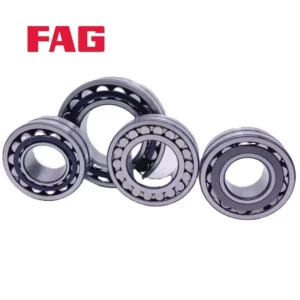
Product details
Description and application notes
Official App Verification — Every FAG 22336-Be-XL-K-Jpa-T41A spherical roller bearing ships with a scannable QR code for instant authenticity confirmation.
Technical Specifications
| Parameter | Value |
|---|---|
| Designation | FAG 22336-Be-XL-K-Jpa-T41A |
| Product Type | Spherical Roller Bearing |
| Bore Type | 1:12 Tapered Bore (K suffix) |
| Arrangement | Double Row |
| Structure | Self-Aligning |
| Material | Chrome Steel Gcr15, with stainless steel or ceramic variants available |
| Cage Material | Steel, brass, or nylon cage options available |
| Precision Class | P0, P2, P4, P5, or P6 options available |
| Origin | Jiangsu China |
Note: Suffixes Be, XL, Jpa, and T41A are unverified and require manufacturer catalog confirmation for exact technical definitions.
Application Suitability
| Industry | Typical Applications |
|---|---|
| Mining | Vibrating screen exciter mechanisms and primary crusher main shafts |
| Steel Manufacturing | Continuous caster roll segments and rolling mill gearboxes |
| Construction | Heavy-duty excavator slewing drives and bulldozer final drives |
Why Overlooking Suffix Codes Destroys the FAG 22336-Be-XL-K-Jpa-T41A spherical roller bearing
Precision in suffix selection prevents catastrophic thermal seizure in high-load environments.
Early in my procurement career, I shipped standard clearance bearings to a Middle Eastern mining site instead of the required high-clearance variant, causing immediate thermal expansion and total machine lockup. That costly mistake proved that ignoring specific suffix codes on a FAG 22336-Be-XL-K-Jpa-T41A spherical roller bearing leads directly to unplanned downtime and severe financial losses. Heavy-duty machinery operates under extreme thermal and mechanical stress, where even a minor discrepancy in the internal clearance or cage design can trigger a cascading failure. Procurement engineers must recognize that every alphanumeric character in the designation dictates a specific metallurgical or geometric tolerance designed to survive these brutal conditions.
Matching Tapered Bore Geometry to Vibrating Screen Loads
The 1:12 tapered bore design allows for secure mounting on adapter sleeves, which is critical for absorbing the intense shock loads found in mineral processing equipment. When sourcing a FAG 22336-Be-XL-K-Jpa-T41A spherical roller bearing, our engineering team cross-references your specific shaft dimensions to ensure the clamping force perfectly matches the operational vibration profile. This precise matching eliminates micro-movements that typically fret the shaft surface over time. Furthermore, the self-aligning capability compensates for structural deflections inherent in large-scale vibrating screens, ensuring that the load is distributed evenly across the entire roller length rather than concentrating at the edges.
Managing Thermal Expansion and Contamination in Crushing Zones
Crusher environments subject components to extreme radial forces combined with heavy particulate contamination, demanding rigorous sealing and lubrication strategies. Elevated ambient temperatures significantly reduce the effective internal clearance, making the correct initial clearance class vital to prevent rolling element skidding. Proper lubrication intervals must be calculated based on the specific cage material and operating speed to maintain an adequate elastohydrodynamic film. Furthermore, misalignment caused by shaft deflection under peak loads requires the self-aligning capability to distribute stress evenly across both rows of rollers. If the sealing arrangement fails to exclude abrasive silica dust, the resulting three-body wear will rapidly degrade the raceway surface finish and accelerate fatigue spalling.
Decoding the Tapered Bore and Self-Aligning Architecture
The K suffix denotes a 1:12 tapered bore, enabling the use of adapter sleeves for precise axial positioning and residual clearance adjustment during installation. This self-aligning structure accommodates shaft misalignment and heavy radial loads without inducing edge stresses on the rollers. Available cage options include brass, steel, or nylon, each offering distinct advantages depending on the vibration intensity and speed requirements of the application. Brass cages typically provide superior durability in high-vibration screens, while steel cages offer a balanced performance for general heavy machinery. The double-row arrangement ensures maximum load-carrying capacity, effectively managing both radial and axial forces simultaneously. Selecting the appropriate cage material is not merely a preference but a critical engineering decision that dictates the component's ability to withstand centrifugal forces and maintain roller guidance under severe shock loading conditions.
The Financial Impact of Incorrect Clearance and Bore Selection
Selecting the wrong internal clearance or ignoring the tapered bore requirements inevitably results in premature fatigue and catastrophic raceway spalling. When thermal expansion is not accounted for, the rolling elements experience excessive preload, generating friction heat that rapidly degrades the lubricant. Such failures not only void manufacturer warranties but also trigger extensive secondary damage to adjacent gearbox components. Analyzing these failure patterns through the lens of standardized classification frameworks reveals that a significant share of premature failures stems directly from initial specification errors. The resulting unplanned downtime in a continuous mining operation far exceeds the initial procurement cost, emphasizing the necessity of rigorous technical validation before finalizing any heavy-duty bearing order.
Securing Traceability and Exact Suffix Verification
We maintain massive spot inventory covering thousands of part numbers, ensuring rapid fulfillment for urgent maintenance requirements without typical multi-week lead times. Our technical selection support specifically targets complex suffix verification, preventing the exact type of clearance mismatches that cause thermal seizures in mining crushers. Every shipment includes complete traceability documentation, allowing you to verify the origin and manufacturing batch of your components. We offer competitive sourcing costs compared to direct official channels while maintaining strict ISO-compliant quality assurance protocols. Additionally, our global shipping consolidation services facilitate the delivery of mixed-brand packages to remote construction or mining sites. By rigorously inspecting every tapered bore component before dispatch, we eliminate the risk of receiving dimensionally out-of-tolerance parts that would otherwise compromise the adapter sleeve locking mechanism.
Documentation & Authenticity
- Certificate of Conformity validating the exact FAG 22336-Be-XL-K-Jpa-T41A designation and manufacturing origin.
- Official app QR code scanning to instantly verify the authenticity of the tapered bore bearing.
- Material inspection reports confirming the metallurgical composition of the Gcr15 chrome steel rings.
- Dimensional inspection data verifying the 1:12 taper angle and bore diameter tolerances before dispatch.
Storage, Handling & Mounting
- Store the self-aligning bearing in its original moisture-proof packaging until the exact mounting date to prevent raceway corrosion.
- Use induction heating for the adapter sleeve installation, strictly monitoring temperature to preserve the structural integrity of the Gcr15 steel.
- Maintain a clean environment during mounting to prevent abrasive mining dust from embedding into the roller-cage contact zones.
- Verify the residual internal clearance after tightening the adapter sleeve lock nut to ensure optimal load distribution across both rows.
Engineering Data Required for Technical Review
Please provide your specific radial and axial load profiles, operating speeds, and ambient temperature ranges so our team can verify the L10 life calculation. Sharing the exact OEM equipment model number allows us to perform a comprehensive cross-reference check against your original machinery specifications. Detailing the installation space constraints and current sealing arrangements ensures we recommend the most appropriate cage and clearance configuration for your application. Supplying historical failure data or maintenance logs from previous installations enables our engineers to identify recurring operational anomalies and propose targeted design modifications that significantly extend the service interval of your critical rotating equipment.
Frequently Asked Questions
Q: How do I verify the authenticity of complex suffixes on this bearing?
A: You can authenticate the designation by scanning the QR code on the packaging using the manufacturer's official mobile application. This digital verification confirms the exact production batch and ensures the tapered bore specifications match the original engineering requirements, protecting your equipment from counterfeit components.
Q: When should I choose a 1:12 tapered bore over a cylindrical bore?
A: A tapered bore is ideal when you need precise adjustment of internal clearance during installation using an adapter sleeve. This configuration is particularly advantageous for vibrating screens and crushers where shaft deflection occurs, as it allows for secure locking and optimal load distribution across the self-aligning roller paths.
Q: What cross-reference considerations apply to cage material selection?
A: When evaluating cross-references to equivalent models, ensure the cage material matches your specific vibration and speed requirements. Brass cages are generally preferred for high-vibration mining applications due to their superior fatigue resistance, while steel or nylon variants might be specified for different operational profiles to maintain proper lubrication film thickness.
Q: How does operating temperature affect internal clearance selection?
A: Elevated operating temperatures cause the inner ring to expand more than the outer ring, reducing the effective internal clearance during operation. If the initial clearance is too tight, this thermal expansion can lead to excessive preload, increased friction, and eventual thermal seizure, making proper clearance specification critical for high-heat environments.









