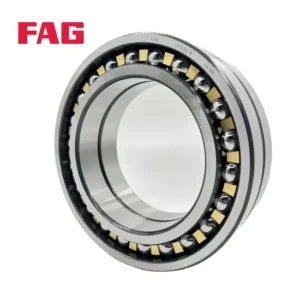
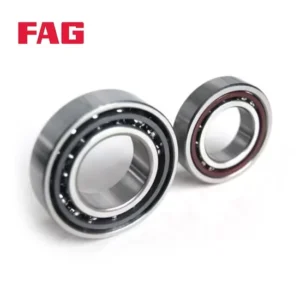
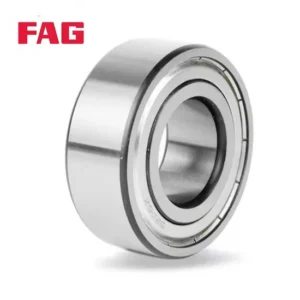
Product details
Description and application notes
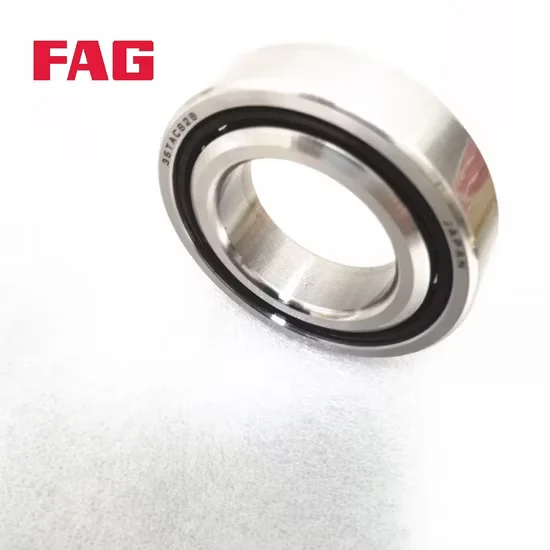
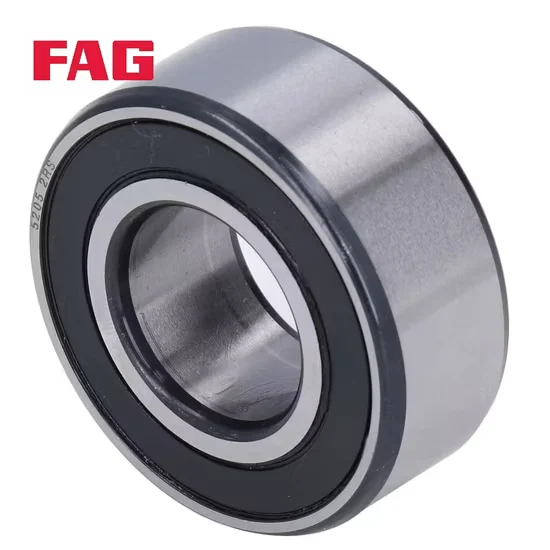
Original Batch Traceability — Every FAG 3308-B-2RS-Tnh double row angular contact ball bearing ships with unbroken manufacturer lot documentation to verify authentic cage and seal materials.
Technical Specifications
| Parameter | Value |
|---|---|
| Designation | FAG 3308-B-2RS-Tnh |
| Product Type | Double Row Angular Contact Ball Bearing |
| Contact Angle | 40° |
| Rows Number | Double |
| Material | Bearing Steel |
| Cage Material | Polyamide, Sheet Steel, or Brass options |
| Seal Type | Two-sided contact seal (2RS) |
| Precision Class | P0 / P6 / P5 |
| Aligning | Non-Aligning |
| Separated | Separated |
| Standards | DIN 628-3, ISO 15:2017 |
Note: The 'Tnh' suffix remains unverified in standard catalogs and requires direct manufacturer confirmation for exact cage material specifications.
Application Suitability
| Industry | Typical Applications |
|---|---|
| Machine Tools | High-speed spindle support and precision guideway drives |
| Industrial Pumps | Centrifugal pump impeller shafts and high-pressure fluid transfer |
| Robotics | Articulated joint actuators and servo motor gearboxes |
| Precision Equipment | Optical positioning stages and automated assembly mechanisms |
When Polymer Cages Melt Inside Sealed Pump Bearings
Thermal limits dictate cage survival long before steel fatigue occurs.
Sourcing a genuine FAG 3308-B-2RS-Tnh double row angular contact ball bearing is only half the battle; misaligning the polyamide cage thermal threshold with the actual operating environment leads to catastrophic seizure. I once tore down a batch of pump bearings returned from a German facility where the nylon cages literally melted into the raceways because the fluid temperature exceeded the polymer's softening point, while the contact seals hardened and leaked. This failure mode completely destroyed the shaft journal and forced an emergency plant shutdown. Procurement teams often focus solely on dimensional interchangeability, ignoring the fact that internal component materials must withstand the specific thermal profile of the application to prevent such devastating mechanical failures.
Matching the 40-Degree Contact Angle to Combined Load Profiles
The 40° contact angle engineered into this FAG 3308-B-2RS-Tnh double row angular contact ball bearing provides the necessary axial rigidity for pump shafts and machine tool sp* maintaining strict sourcing channels, we ensure the internal geometry perfectly matches the demanding combined load profiles of precision equipment, preventing premature raceway spalling under continuous operational stress. When the contact angle is incorrectly specified, the bearing cannot adequately support the axial thrust, causing the balls to ride up the raceway shoulders and generate excessive localized heat. This precise geometric alignment is critical for maintaining rotational accuracy and extending the operational lifespan of high-speed fluid transfer machinery.
Managing Contamination and Thermal Stress in Fluid Transfer
High-speed pump environments subject bearings to aggressive axial thrust, rapid temperature fluctuations, and microscopic particulate ingress. The two-sided contact seals are critical for retaining factory grease and blocking fluid contamination, yet they generate internal friction that elevates operating temperatures. Selecting the correct cage material becomes paramount here, as excessive heat degrades both the lubricant and the polymer cage structure, ultimately compromising the rotational accuracy required for precision equipment. If the thermal equilibrium exceeds the design limits of the seal elastomer, the lips will lose their flexibility, allowing abrasive pump fluids to infiltrate the raceway. Engineers must carefully balance the protective benefits of contacting seals against the friction-induced temperature rise to ensure reliable long-term performance.
Decoding the Suffix Architecture for Operational Stability
The 'B' suffix confirms the 40° contact angle, optimizing the load distribution for applications where axial forces dominate the radial components. The '2RS' designation indicates contacting rubber seals on both sides, which provide superior contamination exclusion compared to non-contact shields, though they impose a strict speed limit due to friction heat. While standard catalogs list polyamide, sheet steel, and brass cage options, the specific cage variant must align with the thermal and speed boundaries of your machinery to avoid the meltdown scenarios I have analyzed in the field. Understanding these suffix designations prevents the costly mistake of installing a high-speed polyamide cage in an environment where elevated temperatures demand a durable brass alternative. Proper interpretation of these engineering codes ensures the bearing operates safely within its designated mechanical envelope.
The Financial Drain of Cage and Seal Incompatibility
Deploying a bearing with an incompatible cage material or seal type in high-temperature applications triggers a cascade of unplanned downtime and secondary equipment damage. According to failure mode classifications, lubricant starvation caused by seal degradation rapidly accelerates surface fatigue and cage collapse. This catastrophic damage voids warranties and forces complete shaft rebuilds, costing exponentially more than the initial component procurement. When a polymer cage fails, the rolling elements lose their spacing and skew, violently grinding against the raceways and destroying the entire housing assembly. Avoiding these hidden costs requires a rigorous upfront evaluation of the operating environment rather than simply defaulting to the cheapest available replacement part.
Securing Authentic Components Through Rigorous Supply Chain Control
We eliminate the risk of counterfeit suffix substitutions by sourcing directly from authorized channels, ensuring the polyamide cage compound and seal elastomers meet exact original factory specifications. Our massive spot inventory allows us to fulfill urgent maintenance requirements for this specific configuration without forcing engineers to accept compromised alternatives. Furthermore, our technical team provides cross-brand equivalent model consultation to verify dimensional interchangeability when upgrading legacy pump systems, backed by comprehensive failure analysis support. By strictly controlling the supply chain, we guarantee that the physical characteristics of the bearing match the catalog data, preventing the dangerous mismatch of internal clearances and material properties that frequently plague the secondary market. This disciplined approach protects your machinery from the devastating consequences of substandard components.
Documentation & Authenticity
- Original manufacturer batch traceability documents verifying the exact production date and cage material compound.
- Official app QR code validation confirming the authentic origin of the 2RS seal components.
- Dimensional and running accuracy inspection reports confirming P0, P6, or P5 tolerances prior to dispatch.
- Certificate of Conformity aligning the bearing specifications with DIN 628-3 and ISO 15:2017 standards.
Storage, Handling & Mounting
- Store the sealed units in their original moisture-barrier packaging to prevent corrosion on the precision-ground outer rings.
- Avoid exposing the 2RS contact seals to direct UV light or ozone, which accelerates elastomer cracking before installation.
- Use induction heating for inner ring mounting, strictly monitoring temperature to prevent thermal damage to the polyamide cage.
- Maintain clean gloves during handling to prevent particulate contamination from adhering to the factory-applied lubricant near the seal lips.
Engineering Review for Optimal Configuration
To ensure the selected configuration survives your specific operating environment, please provide detailed radial and axial load calculations, continuous operating temperatures, and shaft speed parameters. Supplying the original equipment manufacturer part numbers allows our engineering team to perform a rigorous L10 life recalculation and verify cross-reference compatibility. This technical review guarantees the cage material and seal type perfectly align with your machinery's thermal and contamination challenges. Sharing precise operational data enables us to recommend the most reliable internal geometry and lubrication strategy, ensuring the bearing delivers maximum service life under your exact working conditions.
Frequently Asked Questions
Q: How does the 40° contact angle affect axial load capacity compared to smaller angles?
A: The 40° contact angle significantly increases the axial load-carrying capability, making it ideal for applications like pump*aller angles, such as 15° or 25°, prioritize radial loads and higher speed limits but lack the necessary axial rigidity for heavy thrust applications, leading to premature raceway fatigue under similar operating conditions.
Q: What are the cross-reference considerations when replacing open variants with 2RS sealed bearings?
A: Transitioning from open to 2RS sealed variants requires verifying the internal clearance and speed limits, as the contacting seals generate additional friction and heat. Engineers must ensure the factory-filled grease is compatible with the operating temperature range, and confirm that the external housing design accommodates the slightly wider axial footprint of the sealed configuration without causing interference.
Q: How to verify the authenticity of the bearings through official channels?
A: Authenticity is verified by scanning the official manufacturer QR code on the packaging using their designated mobile application, which cross-references the unique batch number. Additionally, reviewing the provided Certificate of Conformity and original batch traceability documents ensures the physical components, including the specific cage material and seal elastomers, match the genuine factory specifications.
Q: What are the selection boundaries between polyamide, sheet steel, and brass cages?
A: Polyamide cages offer low friction and high-speed stability but are restricted by lower thermal limits and chemical sensitivity. Sheet steel cages handle higher temperatures and moderate speeds, while brass cages provide maximum durability under heavy loads, high vibrations, and elevated temperatures. The final selection depends strictly on the continuous operating temperature and the presence of aggressive chemical contaminants.