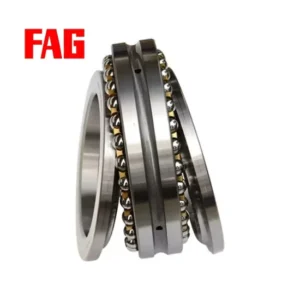
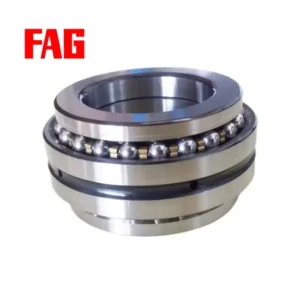
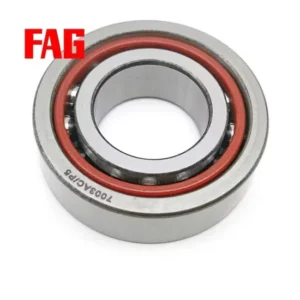
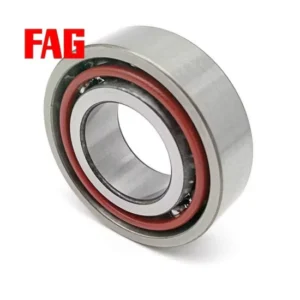
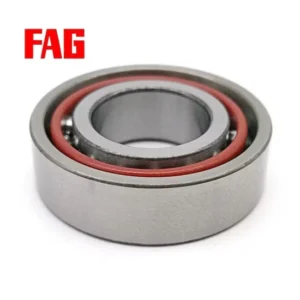
Product details
Description and application notes
Unified Multi-Brand Sourcing — Consolidate this spindle bearing with other premium lines in a single shipment without juggling multiple vendors, simplifying your global procurement process.
Technical Specifications
| Parameter | Value |
|---|---|
| Designation | B71914-E-T-P4s-Dul FAG |
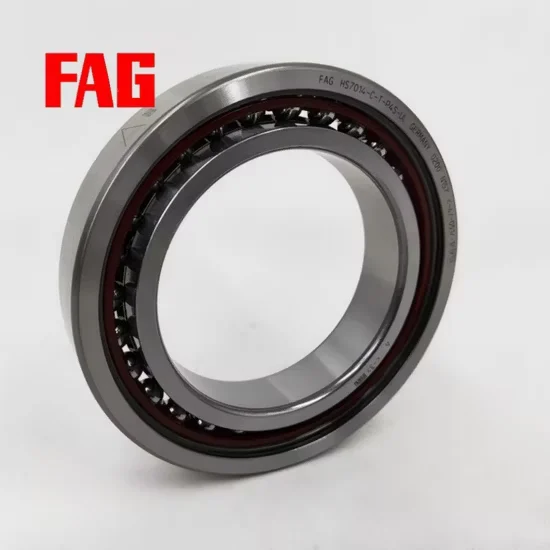
| Bearing Type | Angular Contact Ball Bearing (Spindle Bearing) |
| Precision Class | P4s (ISO) |
| Contact Angle | 25° |
| Material | Available in bearing steel or ceramic variants |
| Arrangement | Single-Row Bearing |
| Origin | Jiangsu China |
Application Suitability
| Industry | Typical Applications |
|---|---|
| Machine Tool Manufacturing | High-speed motorized spindles for CNC milling and turning centers |
| Precision Engineering | Rotary tables and indexing heads requiring tight radial and axial runout control |
Why Spindle Vibration Often Traces Back to a Single Suffix on the B71914-E-T-P4s-Dul FAG angular contact ball bearing
Mismatched preload or precision suffixes silently destroy high-speed spindle assemblies long before the steel actually fatigues.
Early in my career, a European client ordered high-speed equipment bearings, and a missed suffix check led to shipping standard precision instead of the exact configuration required. The resulting vibration at operational speeds caused immediate catastrophic failure upon startup, completely ruining the expensive spindle housing. Such misalignments trigger severe dynamic instability and thermal runaway, making strict suffix verification absolutely critical for avoiding unplanned downtime and protecting your capital equipment. Many maintenance engineers overlook these subtle designation differences, assuming basic dimensional interchangeability is sufficient for precision applications.
Matching High-Speed Demands with Exact Configuration
When integrating the B71914-E-T-P4s-Dul FAG angular contact ball bearing into a motorized spindle, achieving the target RPM requires much more than just basic dimensional matching. The internal geometry must perfectly harmonize with the spindle shaft and housing tolerances to maintain the designed stiffness. Our engineering team provides comprehensive cross-brand equivalent model consultation to ensure the selected configuration aligns perfectly with your specific operational envelope. This proactive technical support prevents costly retrofitting and ensures the machine tool delivers the required surface finish and dimensional accuracy during continuous production runs.
Managing Thermal and Dynamic Spindle Challenges
High-speed machining generates immense centrifugal forces and localized heat, directly altering internal clearance and lubricant film thickness within the assembly. A 25° contact angle balances radial rigidity with axial thrust capacity, yet thermal expansion can still shift the optimal preload zone if the surrounding cooling jacket is undersized or poorly maintained. Proper oil-air or grease lubrication intervals must account for these thermal gradients to prevent raceway smearing and premature degradation. Furthermore, the single-row design demands precise external clamping forces to establish the necessary axial stiffness without over-stressing the rolling elements.
Decoding the Core Engineering Parameters
The 25° contact angle, denoted by the E suffix, provides an optimal compromise for combined loading in precision machining environments where both radial and axial cutting forces are present. Achieving P4s precision ensures exceptionally tight dimensional and running accuracy, which is mandatory for minimizing runout and vibration at elevated rotational speeds. As a single-row arrangement, this design is available in standard bearing steel or ceramic variants, relying on precise external pairing and clamping to establish the correct axial stiffness for the spindle system. Proper configuration ensures the bearing operates within its designed thermal and dynamic limits.
The Hidden Toll of Incorrect Preload Selection
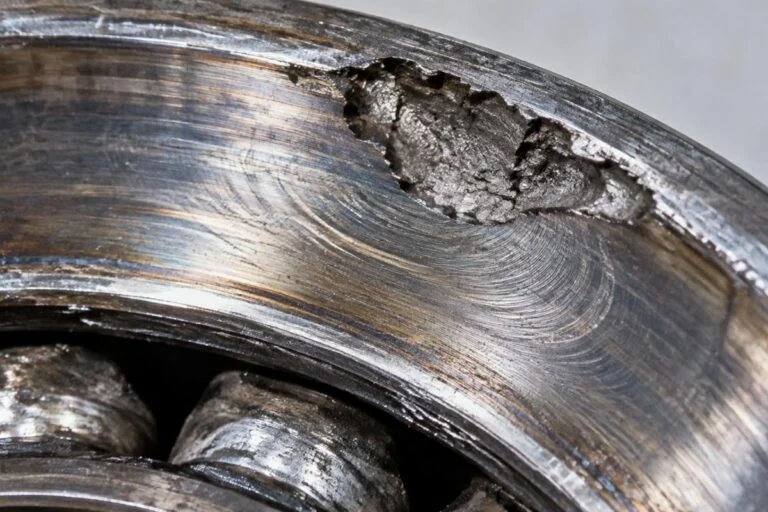
Installing a spindle bearing with the wrong preload configuration leads to accelerated raceway wear, excessive heat generation, and severe thermal runaway. According to ISO 281 standards, dynamic load ratings drop significantly when internal clearance deviates from the design optimum, drastically shortening the expected service life. This mismatch frequently results in premature failure and catastrophic damage to the precision-ground spindle shaft, completely voiding the machine tool warranty and forcing extended production halts. The financial impact extends far beyond the replacement component, encompassing lost production time, scrapped workpieces, and extensive labor costs for spindle rebuilding.
Securing Genuine Precision Through Our Supply Network
Sourcing super precision components demands absolute confidence in origin, traceability, and technical accuracy. We provide genuine original bearings with complete traceability documentation, ensuring the P4s tolerance is authentically met rather than artificially stamped on a substandard product. Our flexible MOQ accommodates everything from single-unit emergency replacements for a broken spindle to full container consolidation for large-scale manufacturing upgrades. We maintain massive spot inventory covering thousands of part numbers, drastically reducing lead times for urgent maintenance scenarios. Furthermore, our technical selection support helps cross-check complex suffix configurations to prevent the exact mismatching errors that ruin high-speed equipment. Finally, our global shipping consolidation ensures these highly sensitive components arrive safely at your facility worldwide, protected from environmental degradation.
Documentation & Authenticity
- Certificate of Conformity verifying the P4s precision class and original manufacturer origin.
- Official app QR authentication to validate the genuine traceability of each spindle bearing.
- Running accuracy inspection confirming tight dimensional tolerances before international dispatch.
- Material certificates matching ISO-compliant quality assurance reports for the steel components.
Storage, Handling & Mounting
- Keep the single-row bearing in its original moisture-barrier packaging until the exact moment of spindle assembly.
- Use clean, lint-free gloves when handling the P4s precision raceways to prevent microscopic corrosion from skin contact.
- Verify the 25° contact angle orientation marks during mounting to ensure correct load path alignment.
- Apply induction heating strictly within specified limits if expanding the inner ring for a tight shaft fit.
Engineering Review and Selection Support
To finalize the integration of this component, share your specific radial and axial load profiles, maximum operational RPM, and precise spindle housing dimensions. Providing the original OEM equipment number allows our team to perform a thorough cross-reference check and L10 life recalculation, ensuring the selected configuration perfectly matches your high-speed machining requirements. This collaborative approach eliminates guesswork and guarantees optimal spindle performance.
Frequently Asked Questions
Q: How can I verify the authenticity of this super precision spindle bearing?
A: Authenticity is confirmed through official traceability documentation and QR code authentication provided with every shipment. We cross-check the physical dimensions and running accuracy against ISO-compliant quality assurance reports. This rigorous verification ensures the P4s precision class is genuine, protecting your high-speed equipment from the catastrophic failures associated with counterfeit or mislabeled components.
Q: What do the unverified suffixes mean and how do they affect spindle preload?
A: Certain unverified suffixes in the designation require direct manufacturer catalog confirmation to define the exact internal clearance and preload state. These parameters dictate how the bearing behaves under thermal expansion and centrifugal force. Misinterpreting these codes can lead to excessive friction or dangerous looseness, making precise catalog verification an essential step before mounting.
Q: Is P4s precision strictly required for high-speed machine tool spindles?
A: Yes, P4s precision provides the tighter dimensional and running accuracy necessary to maintain stability at elevated rotational speeds. Standard precision grades introduce microscopic runout that amplifies into severe vibration and heat generation in high-speed motorized spindles. Utilizing the correct precision class ensures the spindle achieves its designed surface finish and tool life expectations.
Q: How do I select the correct contact angle for my spindle application?
A: A 25° contact angle optimally balances radial rigidity with axial thrust capacity for most precision machining tasks. If your application involves predominantly heavy axial cutting forces, a steeper angle might be considered, whereas higher speed requirements often favor a shallower angle. Sharing your specific load profiles allows our engineering team to recommend the ideal configuration.