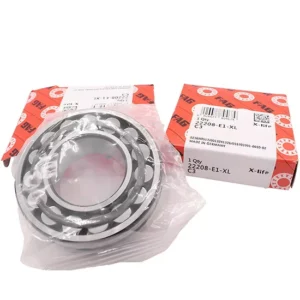
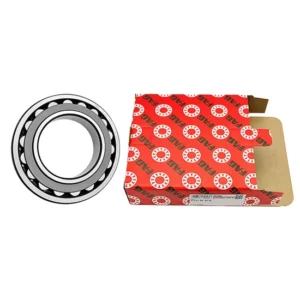
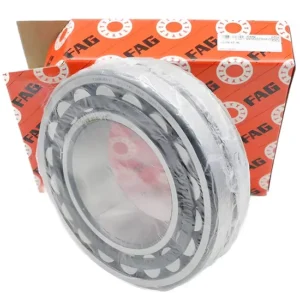
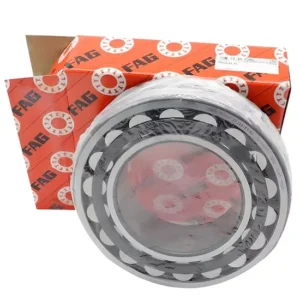
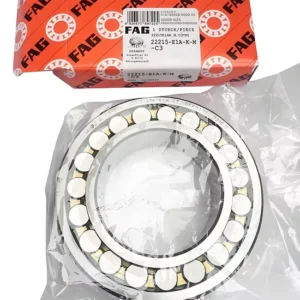
Product details
Description and application notes
Full-Brand Sourcing Coverage — Consolidate your FAG 24140CAK spherical roller bearing orders with mixed-brand heavy machinery packages without juggling multiple vendors.
Technical Specifications
| Parameter | Value |
|---|---|
| Designation | FAG 24140CAK |
| Bearing Type | Spherical Roller Bearing |
| Bore Diameter (d) | 200 mm |
| Outside Diameter (D) | 340 mm |
| Width (B) | 140 mm |
| Bore Type | 1:12 Taper Bore (K suffix) |
| Number of Rows | Double |
| Material | Bearing Steel |
| Load Direction | Radial |
| Lubrication | Grease or Oil |
| Origin | Germany |
Note: The "CA" suffix designation requires verification against the latest manufacturer catalog for specific cage design details.
Application Suitability
| Industry | Typical Applications |
|---|---|
| Mining & Construction | Vibrating screen exciter mechanisms, jaw crusher main shafts |
| Metallurgy | Steel mill continuous casting rollers, heavy-duty gearboxes |
| Pulp & Paper | Paper machine dryer cylinder bearings |
Why Ignoring Taper Bore Tolerances Destroys the FAG 24140CAK spherical roller bearing
Mismatched adapter sleeve dimensions cause microscopic slippage, leading to rapid inner ring fretting and catastrophic shaft scoring.
I used to focus solely on the basic boundary dimensions when sourcing for mining equipment, assuming any standard taper sleeve would suffice. That oversight resulted in severe thermal expansion issues where the inner ring crept on the shaft, eventually seizing the entire assembly during peak operation. Procurement engineers must cross-check the exact taper angle and sleeve draw-up distances to prevent these hidden installation failures. When the locking nut fails to apply the precise axial force, the bearing operates with excessive internal clearance, causing the rollers to skid rather than roll. This skidding action rapidly degrades the raceway surface and generates localized heat spikes that compromise the lubricant film.
Aligning the 1:12 Taper Geometry with Heavy-Duty Vibratory Loads
When dealing with high-impact vibrating screens, the secure locking mechanism provided by the taper bore is non-negotiable. The FAG 24140CAK spherical roller bearing achieves this rigid shaft coupling while still accommodating minor misalignments inherent in heavy structural frames. Our technical team frequently assists plants in transitioning from cylindrical bore setups to this tapered configuration to eliminate the rotational slip that plagues standard press-fit installations under extreme shock loading. Furthermore, the spherical outer raceway allows the inner ring and roller assembly to pivot slightly, compensating for shaft deflections caused by uneven material distribution on the screen deck without inducing destructive edge stresses on the rolling elements.
Managing Thermal Expansion and Lubrication Starvation in Crusher Environments
Crushing applications generate immense radial forces coupled with significant frictional heat, demanding careful clearance selection to compensate for thermal growth. If the internal clearance is too tight, the rolling elements will bind as the inner ring expands faster than the outer ring. Furthermore, the harsh particulate environment necessitates reliable sealing solutions or frequent relubrication intervals to flush out abrasive dust before it penetrates the cage assembly. In dry crushing circuits, airborne silica particles can easily infiltrate inadequate seals, acting as a grinding paste that accelerates wear. Establishing a strict purging schedule ensures fresh grease pushes contaminants out of the labyrinth seals before they reach the critical load zones.
Decoding the K Suffix and Internal Geometry Configurations
The "K" suffix explicitly defines the 1:12 taper bore, a critical interface that requires precise hydraulic or mechanical locknuts to achieve the correct residual clearance after mounting. Unlike cylindrical bores where the fit is predetermined by machining tolerances, the tapered design allows installers to adjust the internal radial clearance by controlling the axial drive-up distance on the adapter sleeve. The double-row roller arrangement distributes the massive radial loads evenly across the spherical outer raceway, granting the assembly its self-aligning capability to absorb shaft deflections without edge-loading the rollers. The cage design plays a vital role here, guiding the rollers to prevent skewing under heavy vibratory forces and ensuring consistent lubricant distribution across all contact surfaces.
The Compounding Penalties of Incorrect Residual Clearance
Failing to calculate the exact clearance reduction during the taper sleeve lock-up process inevitably leads to premature fatigue or excessive operational vibration. An over-tightened bearing will suffer from accelerated roller skidding and cage wear, while an excessively loose setup allows destructive axial play and impact damage to the raceways. These installation-induced failures are often misdiagnosed as material defects, voiding warranties and triggering unplanned downtime that far exceeds the component cost. Maintenance crews frequently blame the steel quality when examining spalled raceways, unaware that the root cause was an improper drive-up measurement that starved the bearing of its necessary internal clearance.
Securing Traceable Inventory for Critical Taper Bore Replacements
Sourcing the correct taper bore variant is notoriously difficult, as suppliers often substitute cylindrical bore equivalents and omit the adapter sleeve. We maintain massive spot inventory specifically segregated by bore type, ensuring you receive the exact FAG 24140CAK spherical roller bearing with full factory batch traceability. Our cross-brand equivalent consultation helps you verify dimensional interchangeability if an urgent alternative is required, while our flexible consolidation shipping handles everything from single-unit emergency MRO dispatches to full-container project rollouts. By centralizing your procurement, we eliminate the administrative burden of coordinating multiple vendors for mixed-brand heavy machinery packages, ensuring all components arrive synchronized for your scheduled maintenance windows.
Documentation & Authenticity
- Certificate of Conformity linking the specific FAG 24140CAK batch to the original German manufacturing facility.
- Official app QR code verification confirming the 1:12 taper bore geometry and bearing steel composition.
- Dimensional inspection reports validating the exact 200 mm bore and 340 mm outside diameter tolerances.
- Material traceability documents proving the metallurgical grade of the inner and outer rings.
Storage, Handling & Mounting
- Store the FAG 24140CAK spherical roller bearing in its original vapor-phase inhibitor packaging until the exact moment of mounting to prevent taper bore corrosion.
- Use induction heaters with strict temperature limits when warming the inner ring, avoiding localized overheating that alters the bearing steel microstructure.
- Measure the axial drive-up distance on the adapter sleeve meticulously to guarantee the specified residual radial clearance is achieved.
- Apply clean lint-free gloves when handling the exposed double-row roller assembly to prevent acidic skin moisture from initiating surface pitting.
Preparing Your Technical Parameters for Precision Selection
To ensure the selected taper bore configuration perfectly matches your machinery, please provide the exact radial and axial load profiles alongside the operational speed and ambient temperature ranges. Sharing the original equipment manufacturer's part number or the existing adapter sleeve dimensions allows our engineering team to perform a rigorous cross-reference check and calculate the optimal initial clearance required for your specific shaft locking method. Additionally, detailing the housing sealing arrangement and current relubrication intervals enables us to recommend complementary accessories that will maximize the operational lifespan of the replacement unit.
Frequently Asked Questions
Q: What does the K suffix indicate on this specific spherical roller bearing?
A: The K suffix designates a 1:12 taper bore, meaning the inner ring is designed to be mounted on a tapered shaft or an adapter sleeve. This configuration allows for precise adjustment of internal radial clearance during installation, providing a highly secure and rigid locking mechanism essential for heavy-duty vibrating and crushing applications.
Q: How do we verify the authenticity of the delivered bearings?
A: Every unit is supplied with original factory batch traceability documents and a unique QR code. Procurement teams can scan this code using the manufacturer's official mobile application to instantly verify the production origin, material specifications, and dimensional data, ensuring the components are genuine and fully compliant with your quality assurance protocols.
Q: What cross-reference factors matter when replacing existing cylindrical bore units?
A: Transitioning from a cylindrical to a tapered bore requires verifying the shaft journal dimensions and selecting the correct adapter sleeve or withdrawal sleeve. Our technical team evaluates the housing bore, axial space limitations, and locking nut clearance to ensure the replacement integrates perfectly without requiring structural modifications to the existing machinery housing.
Q: How should internal clearance be selected for high-temperature environments?
A: In applications where the inner ring operates significantly hotter than the outer ring, thermal expansion reduces the internal radial clearance. Engineers must specify an initial clearance class, such as C3 or C4, to compensate for this differential expansion. Providing exact operating temperatures allows us to recommend the precise clearance needed to prevent binding under load.
Q: What are the recommended lubrication practices for this double-row design?
A: The open design supports both grease and oil lubrication depending on the application speed and cooling requirements. For heavy-duty, low-speed crushing environments, a high-viscosity grease with extreme pressure additives is typically applied, while high-speed vibrating screens often benefit from continuous oil circulation to manage frictional heat and flush out wear debris.